
Chemical rockets are one of humanity’s greatest engineering achievements: the workhorses we’ve used to get off this rock since the dawn of the space-faring age. They’ve taken us from pad to orbit, the Moon, and the outer planets. Chemical rockets are robust, deeply understood, and polished by six decades of relentless iteration.
And yet.
Each new generation of engine buys us modest performance (3-5% efficiency gains) at tremendous costs and diminishing returns. As we invest heavily in refining a chemical combustion technology that has almost reached its thermodynamic ceiling, we are in effect attempting to sharpen a knife by honing it on a stick of butter.
So we have a choice. Either we accept that the solar system ends at low Earth orbit, or we take the next step in energy conversion.
The Rocket Equation
Chemical rockets are marvels of energy concentration, channeling reactions between fuel and oxidizer into colossal thrust. But they are fundamentally constrained by the physics of chemical bonds. Even with advanced propellants, chemical density tops out at ~10 megajoules per kilogram, which caps the best hydrogen-oxygen engines at ~450 seconds of specific impulse.
(Rocket performance is often summarized by specific impulse (“Isp”): how many seconds an engine can produce a unit of thrust per unit weight of propellant expelled. Higher Isp means more propulsive energy or delta-v is added to the spaceship per kilogram of fuel.)
On its own, that ceiling sounds abstract — until you run it through the rocket equation, which tells you what that limit does to your mass and mission design. We’ve already chased this frontier into the mid‑400‑second Isp range with the high‑end hydrogen‑oxygen engines flying today. And the rocket equation punishes every inefficiency: as required delta‑v rises, propellant mass grows explosively, dragging tanks, structure, and staging hardware along for the ride.
As long as we stay inside the chemical energy box, most of every deep-space vehicle will always be propellant. Thus the search, by many a rocket scientist, for fundamentally different propulsion that breaks out of the chemical regime and makes a different kind of mission possible.
An Alternate Reality
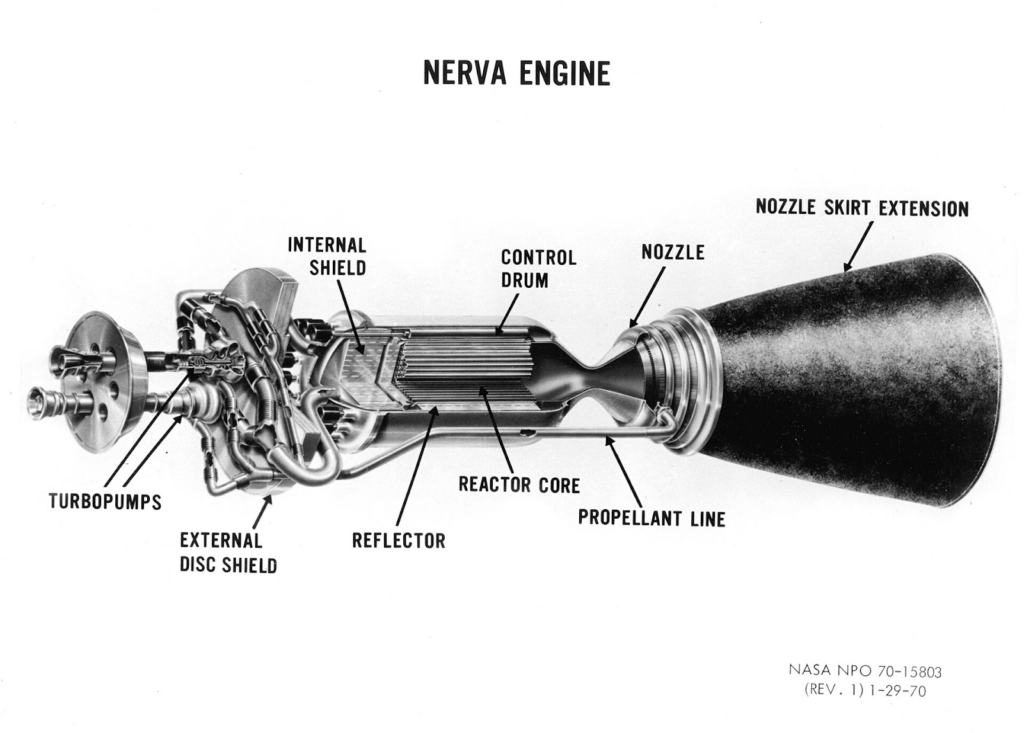
In the early to mid 1960s, yours truly (Dan) worked on nuclear thermal propulsion during the NERVA program, which heated hydrogen propellant in a hot nuclear reactor and expelled the hot gas out conventional nozzle to obtain thrust. We built, ground fired, and iterated on the hardware, with NERVA’s XE engine meeting the performance requirements for human Mars missions. The physics and engineering worked.
Because fission fuel is millions of times more energy‑dense than chemical propellants, NERVA‑class systems opened up trajectories that were essentially off‑limits to chemistry alone: shorter Mars trips, higher‑energy outer‑planet missions, and architectures that could haul serious payload instead of flying flags‑and‑footprints sorties.
Then, in 1972, with no technical showstopper, NERVA was cancelled and the reactors were mothballed.
If we had kept going, nuclear thermal engines could plausibly have been flight-qualified as upper stages and deep-space tugs, with halved Mars transit times by the ‘90s and nuclear-electric, deep-space cargo freighters running continuous low-thrust supply routes to the outer planets in the 2000s.
Instead, we got five decades of paper studies, PowerPoints, and conference presentations on nuclear propulsion, while we dutifully sharpened our chemical blade.
The Two Engines Worth Building
There are two nuclear propulsion technologies worth pursuing at scale, and they behave very differently.
FISSION THERMAL PROPULSION: Instead of burning propellant to generate heat, a nuclear thermal engine uses a compact fission reactor as the heat source – and hydrogen, the lightest element in the periodic table, as the working fluid. Liquid hydrogen is pumped through the reactor core, heated to extreme temperatures, and expelled through a converging‑diverging nozzle.
Typical nuclear thermal designs derived from NERVA testing cluster around Isp ≈ 875–950 seconds, roughly 2× the ~450 seconds achieved by state‑of‑the‑art hydrogen‑oxygen cryogenic combustion engines.
The payoff is in the mass budget and mission architecture. With nuclear thermal, propellant stops devouring almost the entire vehicle. Propellant mass fraction drops from ~85% of liftoff weight toward ~60% for comparable mission energy, turning a 15% payload into something closer to 40%.
Instead of merely proving you can arrive somewhere with a stack of tankage and fuel, you get there with enough mass to build something – habitats, depots, surface power, manufacturing – on the first wave.
FISSION ELECTRIC PROPULSION: Fission electric systems share the same reactor backbone for thermal energy but assign it a different job. Rather than heat the propellant directly, the reactor generates electricity to power ion or Hall‑effect thrusters that accelerate charged particles to exhaust velocities well beyond what any thermal process can achieve. Flight‑proven ion engines like NSTAR operate around Isp ~3,000 seconds, while next-generation concepts target 4,000-10,000 seconds for outer-planet missions – an order-of-magnitude leap over chemical.
The tradeoff is thrust: these engines push gently, not violently. They barely consume any fuel compared to chemical stages. They produce only a whisper of thrust at any moment, but they can run for months or years and can accelerate your ship to velocities that chemprop could only dream of.
That changes how you think about the entire solar system. A spacecraft with 5-10x the acceleration time capability of a chemical stage is not beholden to the narrow launch windows that chemical propulsion imposes. It can spiral outward, reshaping its orbit rather than blasting onto a single narrow trajectory. Launch windows widen. Cargo can depart when it’s ready or needed, not just when celestial mechanics gives you a two‑week shot every 26 months.
Can you get the best of both worlds? Of course you can, by splitting the stack. Cargo rides the slow burn (nuclear electric tugs that spiral outward on efficient, continuous‑thrust trajectories), while crews ride nuclear thermal “fast lanes” that minimize time in deep space.
The Safety Obligation
As you can see, I am about as bullish as one can be on nuclear propulsion. But I’m equally insistent that we not cut any corners on our safety obligations.
Nuclear material is dangerous when a mission isn’t planned for it properly. During the Cold War, the Soviets launched nuclear power systems into orbit with a few unanticipated gaps in their safety architecture. Several failed in ways that scattered radioactive material, with consequences for people on the planet, for public trust, and for the long-term prospects of space nuclear power (that is to say there were severe and lasting consequences). We in America made our own mistakes in that era, too. The pressure to move fast outran the discipline to move carefully.
I know this firsthand. When we at NASA flew the highest-power radioisotope power system, protestors chained themselves to the fence at Kennedy Space Center. I was the NASA Administrator.I sent a message to the President that I was directly responsible for the outcome of the mission and it was safe. I said: I have had my team perform a worst-case safety analysis. I know what happens if this vehicle fails at every point in the trajectory and I understand the impact on humanity would be minimal and acceptable. I am personally responsible. Hold me accountable. And I meant every word.
This is what a genuine safety case looks like. It means you can stand before any audience, explain exactly what happens if everything goes wrong, and defend the conclusion that the risk to people on this planet is acceptable.
Before a nuclear-powered spacecraft leaves the pad in this brave new age, we need to ensure we’ve done such an analysis with the same level of rigor. If a reactor fails at the worst possible point in its trajectory and re-enters, what is the impact on radiation exposure on the ground? That question has to have a clear, documented, defensible answer.
We built that safety culture before. We can build it again. But it can’t be treated as a box to check on the way to a launch approval.
Why This Time Could Be Different
The equations for this concept were first sketched out when Dwight Eisenhower was president. Yet across six decades, the U.S. has flown exactly one space fission reactor, SNAP‑10A, which ran for 43 days before a (non-nuclear) electrical failure shut it down. Every subsequent nuclear propulsion push has been cancelled before it could survive into an administration that didn’t launch it: NERVA in the 1970s, SNTP in the 1990s, Prometheus in the 2000s…
We are not the only ones who noticed the gap this left. The Russians and Chinese have quietly kept space-nuclear work alive. In 2023, DARPA and NASA followed suit and stood up DRACO, a plan to flight-test a low-enriched uranium nuclear thermal stage for cislunar operations by 2027. (DRACO succumbed to the same fate as all of its predecessors; it was cancelled last year.)
DRACO’s cancellation is often cited as nuclear propulsion “losing” to Starship. That’s not exactly what’s happened. Cheap, reusable chemical launch (e.g. Starship-class vehicles) solves the Earth-to-orbit problem, but not the orbit-to-everywhere-else problem. You can stack more propellant and fly more tankers, but as long as you’re sharpening the knife on butter within the chemical energy box, the rocket equation will still eat your mass budget. Nuclear propulsion, then, shouldn’t be seen as a competitor but a complement to reusable launch.
What breathes new life into this concept is the hardware and the mission pull. Modern micro-reactors, some under ten tons, are being designed as factory-built, truck-portable units in the single-digit MW range, able to run autonomously for years without atmospheric oxygen, maintenance windows, or continuous coddling.
You can do something your grandparents could not: you buy one reactor class and use it twice. First it powers the Moonbase, the radar, the depot, or the industrial park in one-sixth gravity. Then you bolt that same architecture to an electric stage and send deep-space freighters on a years-long burn. The hardest parts — fuel cycles, safety cases, launch approvals, supply chains — are amortized across power and propulsion together.
This could be what finally breaks the chicken-and-egg problem that has killed past programs. You no longer need to justify a bespoke, single-use space reactor line item. The reactor already exists because forward-operating bases on Earth and outposts on the Moon need power. The propulsion case is merely piggybacking along for the ride.
The Right Partnership
Space nuclear propulsion lives in a lane almost nobody can navigate alone. The political and safety risk is too high for a purely commercial bet – no private company is going to absorb the cost of nuclear licensing, launch approvals, and public acceptance alone. But it’s also too operationally complex, too iteration-dependent, and too cost-sensitive to be managed as a traditional NASA program with decade-long procurement cycles and without competition.
The model that would work here is the one that has already worked: NASA as architect and referee, industry as builder and cost-driver. The agency brings flight heritage, systems integration experience, a deep safety culture, and access to test facilities designed for nuclear materials and vacuum conditions. Industry contributes pace, flexibility, and cost discipline born from commercial competition. The industrial base is already racing to field modern microreactors for terrestrial applications. Space propulsion can ride on this momentum.
Launch approvals for nuclear hardware will not be rubber-stamped. Public acceptance is fragile and fickle. Shielding, contamination risk, and fail-safe disposal are all engineering constraints that we must manage. But none of this means we should keep ourselves confined in the chemical box. Rather, this is a reason to pair NASA’s safety culture and regulatory experience with industry-led development.
Before the Decade Is Out
A single class of compact, MW-scale reactor can sit at the south pole of the Moon, in the back end of a nuclear-electric tug, or behind the fence at a forward operating base. The drawings, the fuel supply, the licensing fights, and the trained workforce are largely the same across all three. That shared supply chain and industrial base, something NERVA never had, can be what finally breaks the U.S. from its cancellation cycle – expressly because the reactor isn’t a line item that has to be justified in a space exploration budget anymore.
Before 2030, we’d like to see the U.S. do three things:
- Qualify a single compact reactor class for both lunar surface power and in-space propulsion duty.
- Fly a nuclear‑electric demonstration tug in cislunar space or to Mars, moving actual payload on a schedule.
- Stand up a NASA-led, industry-built program office whose explicit mandate is to iterate hardware every few years instead of once a generation.
The physics have been settled since President Dwight Eisenhower. The industrial base is further along than it has ever been, across a new wave of bus manufacturers, propulsion vendors, and ambitious SMR developers hungry to deploy and scale their designs. After all, these reactors are already being built for terrestrial applications. The thruster technologies are already flying on commercial spacecraft today. If not now, then when? I watched us prove it once. I’d like to see us do it again. And just to make an old NASA Administrator smile, researchers who have the intellectual capacity and imagination to take on truly hard problems at national labs, NASA, universities or in corporate think tanks reach for the wild and crazy beyond the limits of our present knowledge of physics, perhaps concepts like Warp Drive?