
Last year, a datacenter developer started working the phones along Green Hill Road in Silver Spring Township, PA, outside Harrisburg. Mervin Raudabaugh got the call: a mystery buyer wanted to buy his 261 acres of farmland. The developer offered him $60,000 an acre for the land the 86-year-old had farmed for six decades. Mervin turned it down, selling to Lancaster Farmland Trust for <$2M instead, thereby locking the soil into agricultural use. “I was not interested in destroying my farms,” he told a local Fox affiliate.

Two things about this story might have been unthinkable a generation ago: that anyone would offer a farmer nearly $16M for that land, and that it’d be worth more dead (paved over) than alive (producing food).
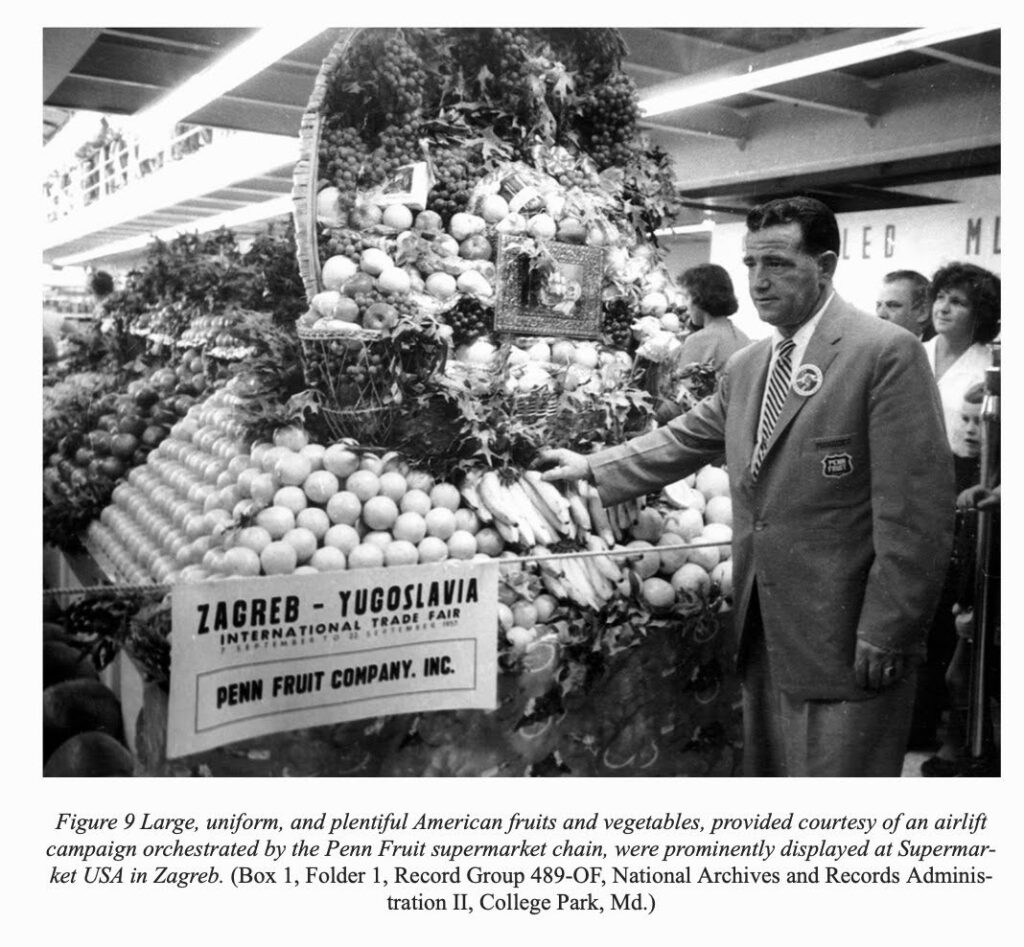
The Supermarket of the World
For the better part of a century, that’s what America was. From 1959 through 2018, the country ran an agricultural trade surplus every single year, peaking near $27B in 1981, when soybeans, corn, wheat, and rice flowed out of the heartland in volumes that functioned as soft power and hard trade leverage. (When the Soviet harvest failed in 1963, Khrushchev had to buy American wheat through private US grain companies: at market rate, without credit, shipped on American vessels, which was a humiliation leveraged by his enemies to oust him the following year.)
Then, in 2019, the curves crossed. The U.S. has since run a deficit in four of the last six fiscal years. Last year, we imported $43.7B more in agricultural products than we sold.
Washington has started saying the right words. Last month, the USDA and Department of War signed a memorandum designating agriculture as a national security priority. Multiple bills linking food security to national security percolated through the last Congress. If you talk to the right folks in Washington, you’ll hear agriculture now being discussed the way semiconductors were in 2021 — as a sovereign capacity that a serious country cannot offshore.
All of which sounds right, none of which changes what is happening on the ground. Because the ground is the problem.
Land gets more expensive; farming gets less profitable
In real estate, you think in square feet, in proximity, in comps. Farmland trades in acreage, water tables, growing seasons, and soil composition. And right now, profitably farming that acre is just about the hardest it’s ever been.
Since 2020, seed costs have climbed 18%, fertilizer 37%, fuel 32%, and interest on operating loans 73%. Labor is up 50%. These costs never came back down after the 2021-22 supply chain shock, but crop prices did, creating a double squeeze on farmers. Farmland has appreciated nearly four-fold from ~$1,090/acre in 2000 to $4,170 in 2024.
Some 40% of U.S. farmers are over 65. The American Farmland Trust estimates nearly 300M acres will change hands through inheritance in the next two decades. When it does, the math facing each heir will look a lot like Mervin’s. What would you do: keep farming a business with collapsing margins, or if one was offered, take the check?
A Collision of Old & New Economies
Datacenters, chip fabs, and other megaprojects need what farms need: flat land, abundant water, reliable power, and access to transport.
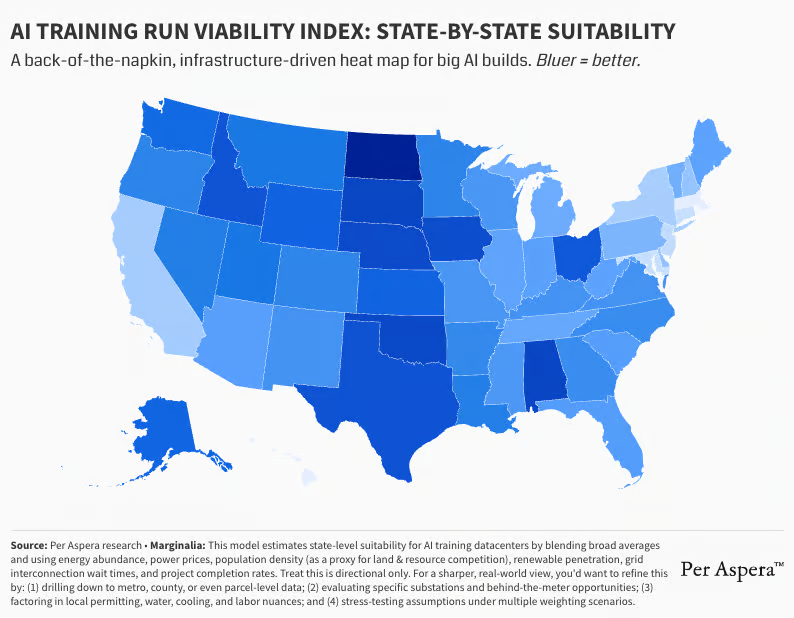
In Loudoun County, VA, ground zero of America’s datacenter buildout, farmland already lists at $55,000–$79,000/acre, a significant premium over the statewide average because markets are pricing in the possibility the land will convert from farmland to computerland.
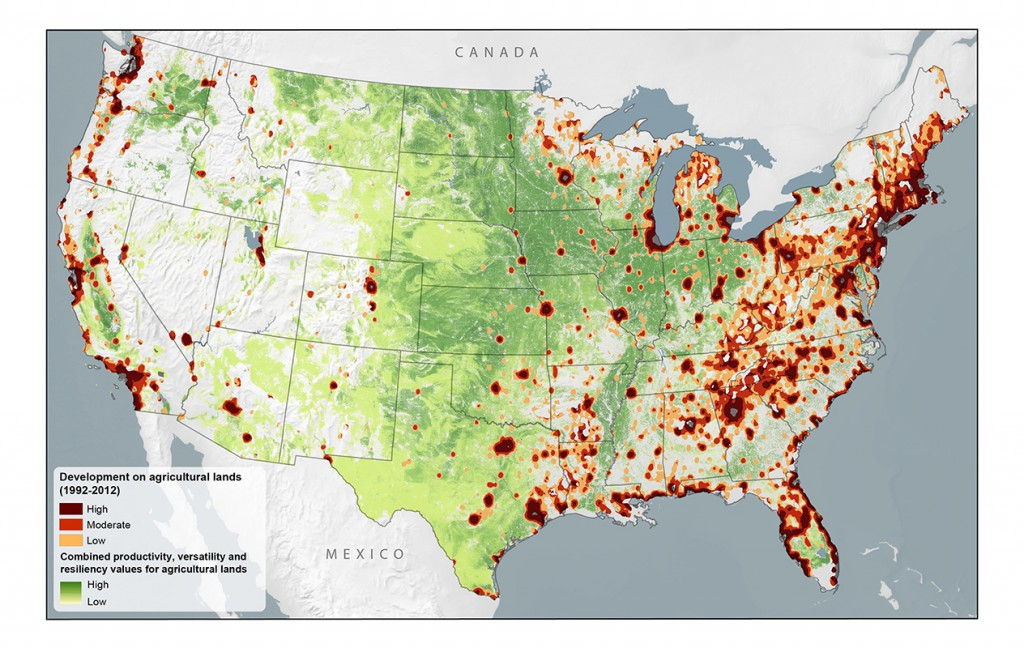
Conversions are large and getting larger. Meta’s $10B compute cluster in Richland Parish, Louisiana, sits on 2,250 acres of former soybean fields. Samsung’s new $17B fab occupies 1,200 acres outside Taylor, Texas, a town that once called itself the largest inland cotton market in the world. Micron’s $100B megafab is going up on 1,400 acres of former agricultural land and wetlands in Clay, New York. These are some of the largest private investments in American history, and among the most economically and strategically consequential bets we’re making as a country. You can’t help but notice the symbolism of it all: each is being built on rural land that was growing something one or two generations ago.
Datacenter developers, who already need some PR help, have seen local opposition to these projects emerge as a real planning risk, with farming families showing up at county meetings to argue that once the land converts, it will never come back.
Nobody should pretend this is irrational. A fab generates more economic value per acre than any soybean field ever will, the jobs pay better, and the strategic logic of onshoring chips is sound. But the math that makes each individual conversion obvious is the same math that, in the aggregate, leaves you structurally short on food. The country is losing about 2,000 acres a day, with 18M more projected to convert by 2040.
The Flow of Capital
As Washington works to subsidize the farming, to the tune of $10–$15B in federal support each year, Wall Street is betting on the land underneath it leaving farming.
Nuveen Natural Capital, a subsidiary of TIAA, manages $13.1B in farmland across 3M acres globally and recently launched a REIT targeting $3B in new capital. Those holdings have appreciated far beyond what crop income would justify, because it follows the pattern of a conversion optionality play: buy well-located agricultural land at agricultural tax rates and wait for rezoning.
Nearly 95% of American farms are still family-run, but most are modest operations. The 6% of farms generating $1M+ in sales produce 78% of everything, up from 69% just five years ago. Farming has developed the power-law distribution of a winner-take-most industry, except the winners don’t get to set their own prices. The family farm persists in name, but the economics (and economies of scale) increasingly push it to operate like a corporation or exit.
And institutional investors have some strange bedfellows on their side of the orderbook. Foreign investors held an interest in nearly 46M acres as of 2023 – 3.6% of all privately held farmland – up 85% since 2010. Canada alone holds 15M acres. China, which cannot feed its population from its own soil, built COFCO International into a state-backed grain trader that does $38.5B a year and accumulated millions of acres globally. Saudi Arabia was pumping Arizona’s groundwater through Fondomonte, a state-linked operation growing alfalfa for export, until Arizona killed the leases in 2023. Those countries treat productive soil as something worth a sovereign premium, and something you want to physically control.
A Brief History of Agro-Doomerism

In 1798, Thomas Malthus observed that population grows geometrically while food supply grows arithmetically, and predicted that famine was a mathematical certainty. He was wrong. Mechanization, fertilizer, and crop science unhobbled the arithmetic constraint and fed a population that grew sevenfold after his essay was published. In 1968, Paul Ehrlich recycled the argument for a new generation, predicting hundreds of millions would starve in the 1970s. Wrong again.
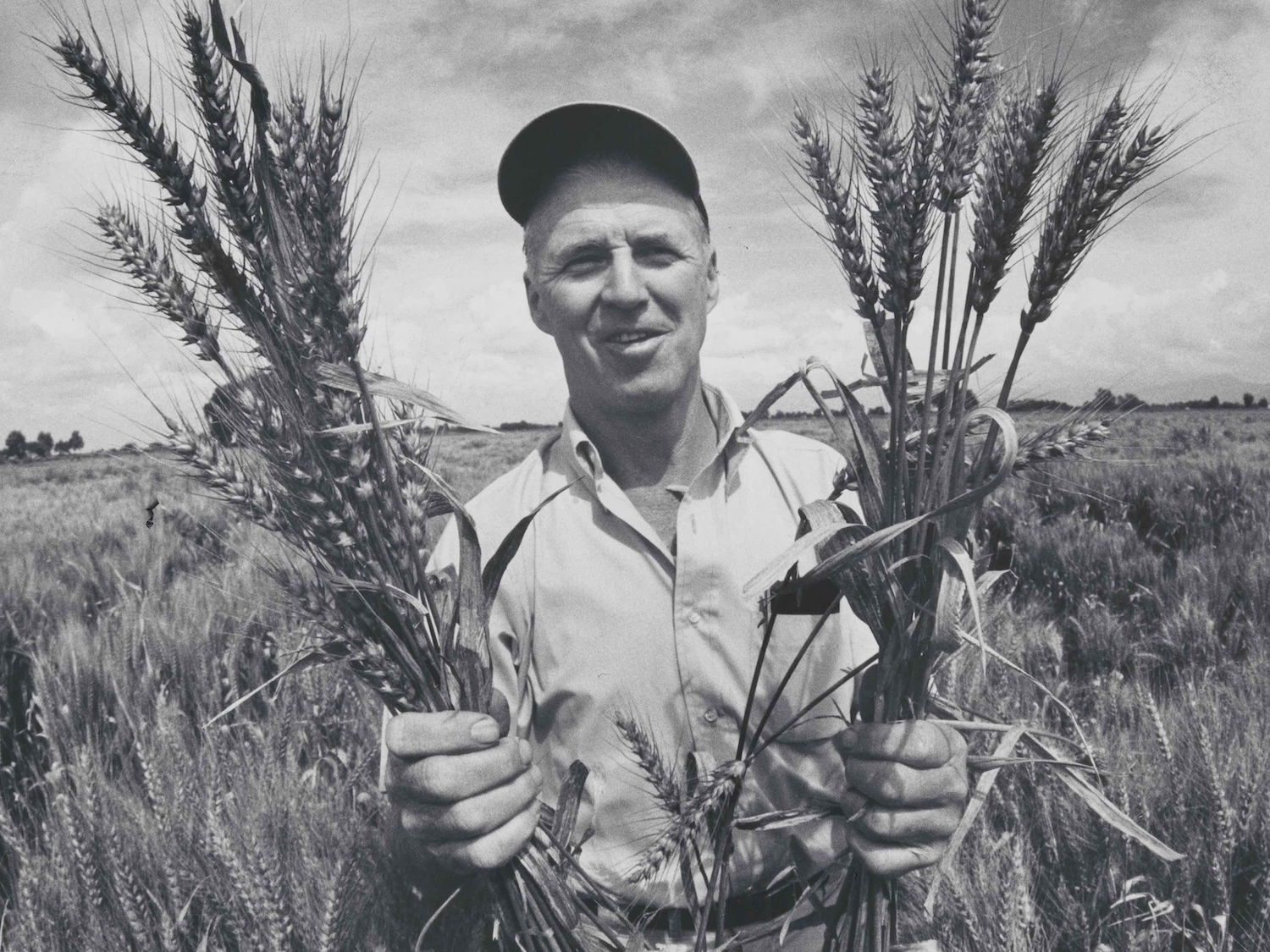
Norman Borlaug (pictured above, at right) had already started doubling wheat yields across Mexico and India with dwarf varieties and fertilizer protocols that would win him the Nobel Peace Prize and, by some estimates, save a billion lives. U.S. corn is a remarkable testament to technology’s productive capacity: we could farm 26 bushels per acre in the 1930s, and 179 today – a nearly 7x increase on roughly the same footprint.
But what’s happening to American agriculture today is not primarily a yield problem. We grow plenty of food. The challenge is that the ground itself increasingly commands a higher price for non-ag uses. The fix has to be economic: make a working acre generate enough revenue that farming it can compete with paving it over.
Convergence vs. Conversion
“The rest of every square inch is going to get built on,” says our earlier protagonist, Mervin. “The American farm family is definitely in trouble.” Mervin chose the soil over the check, and he knows this decision, which resisted capitalistic logic, is the exception that proves the rule. His logic is unlikely to be repeated across the 300M acres that will change hands in the coming years.
Washington (and Maslow’s Hierarchy) say that farming is a sovereign capacity that one cannot afford to surrender. But Mr. Market says the incremental American acre wants to leave agriculture. Both are true, but both cannot hold forever. It doesn’t need to be zero-sum. We shouldn’t have to pick between forced preservation and increasingly inefficient subsidies, and accommodating the American Dream (more housing) in new places or strategically vital megaprojects.
This is a hard problem, but it is a solvable one, as shown by the long history of technological revolutions in agriculture. Today, a set of technologies that were each too expensive or immature a decade ago have converged to the point where the raw inputs for a farm, ex land, can get radically cheaper, all at once:
- Solar and storage. Installation costs have dropped 87% since 2010. Battery storage fell 45% in 2025 to $70/kWh. A farm that generates its own power can slash one of its largest fixed costs and sell the surplus.
- Desalination. We need ways to obtain freshwater that doesn’t depend on a snowpack or river compact. Texas is building seawater desalination at $12,000 per acre-foot of annual capacity; the Saudis did it for <$10,000 and have been growing export crops in the desert with the output for years. We’ve argued before that a solar/storage/desal megaproject is the only serious answer to western water scarcity.
- Precision agriculture. This is a longer topic for another day, but suffice it to say that there is measurable, notable progress in this long-hyped department. John Deere’s See & Spray, for example, covers 5M acres and cuts herbicide bills by nearly half.
- Connectivity. Starlink (we’ve written about this before) has dropped broadband onto rural land that couldn’t get a cable hookup five years ago, which allows an enabling technology to proliferate more heavily across agricultural land.
We see concepts of a plan – hints at a solution — at varying degrees of scale. Across 560 “agrivoltaic” sites in the U.S., farmers lease their land to solar operators while growing/grazing underneath, collecting energy and crop revenue from the same parcel (Silicon Ranch runs 3.6 GW of utility-scale solar with commercial sheep grazing below the panels). QScale in Quebec pipes datacenter waste heat into greenhouses designed to produce 80,000 tons of tomatoes a year, turning computers into the farm’s tenant rather than its replacement. Gotham Greens and Little Leaf Farms built profitable indoor growing businesses, emerging as battle-scarred survivors in a sector where $10B in VC went to die.
None of this is enough yet. Fortunately, diffusion and distribution are massive levers – and market opportunities – by themselves. As a third of the nation’s farmland changes hands over the next 20 years, heirs will face a farming income halved over thirty years on one side of the ledger and a developer’s check on the other.
The long arc of agro-doomerism and technological revolutions say there’s reasons for optimism. Many times before, the “math” said we’d run out of food; many times before, new science, systems, and processes came along that changed the denominator and proved the doomers wrong. Hoping and praying for AGI or another Norman Borlaug to save our bacon is not a strategy, but abundance-oriented technology stacks that don’t force a zero-sum choice between preservation and productivity might be. We should look at systems that help unfallow and uplift acres, making farmland competitive enough that we don’t pave over too much and one day realize we want the topsoil back – or our ag trade deficit erased.
The bet worth making is 1) to never bet against America, of course, and 2) that something similar will happen here: that productivity, not preservation alone, will close the gap. This is a generational opportunity, a category deeply in the national interest, and a sector wanting more capital, technology, engineers, and founders to show up. Those who get there first will be serving a gigantic market, and attacking a problem that Washington has acknowledged is existential but has no idea how to productively solve.
The supermarket of the world was built on cheap land and cheap water. Neither are cheap anymore, and both are being bid up by us – via population growth – as well as the industrial renaissance that we care so deeply about. But that doesn’t mean we can forget foundational inputs – literally – to our way of life.