
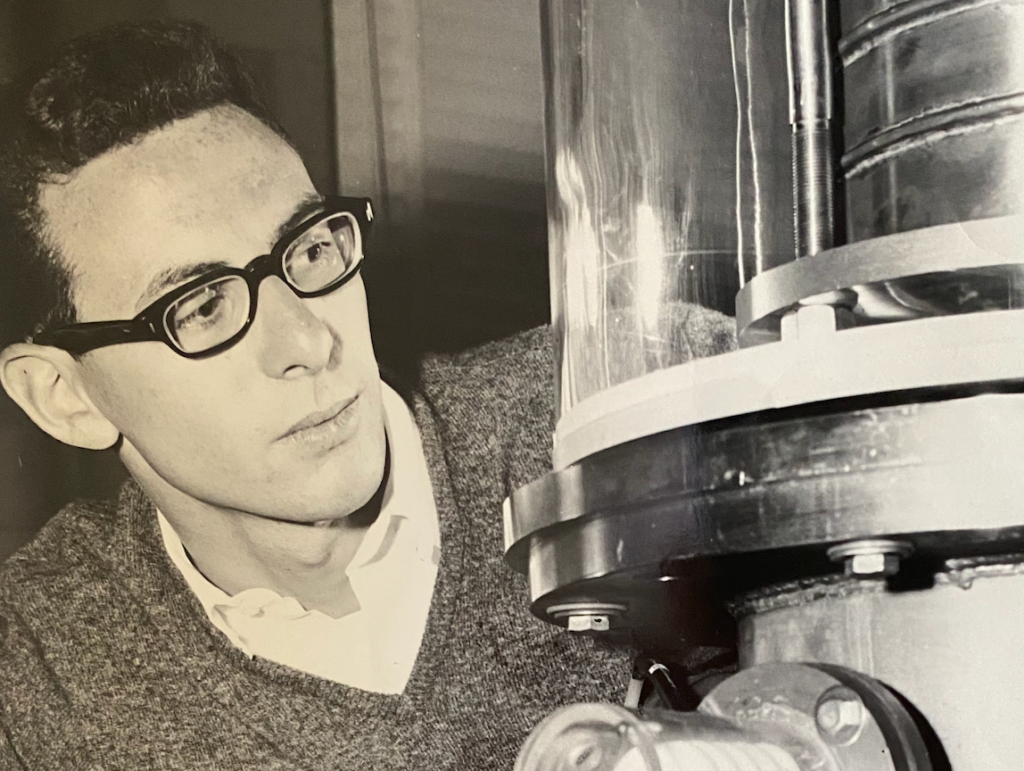
It’s been 65 years since I heard John F. Kennedy’s speech in Spring of 1961, when he committed America to go to the moon before the end of the decade. When I heard that, I decided to skip graduate school at CCNY and apply straight to NASA.
No speech since has moved me the way it did — until this past weekend.

I was killing time at the airport on Sunday, scrolling through my phone, when I came across Elon Musk’s Terafab presentation — delivered Saturday night at the old Seaholm Power Plant in downtown Austin, Texas. As I got into his speech, I said to myself — holy crap! 😱 and sent a note to my colleagues: you have to watch this!
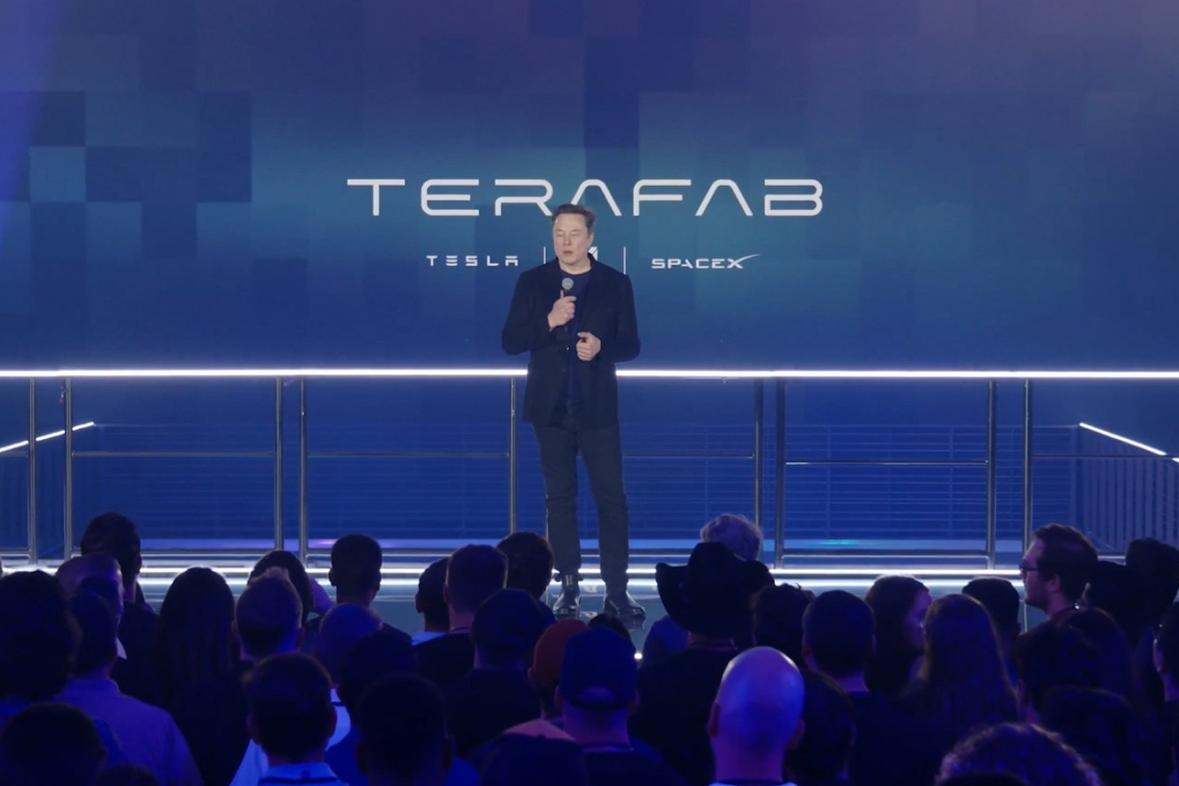
What we saw this weekend — which, of course, we didn’t see much of in the traditional media — was, I believe, one of the most consequential industrial announcements in modern American history. And it wasn’t because of lunar mass drivers or space datacenters. Allow me to explain.
What Musk laid out
Tesla, SpaceX, and xAI – recently tucked in to SpaceX – intend to build the largest semiconductor fabrication facility ever attempted. A 100M sqft, $20-25B plant in North America. Specifically, on the North Campus of Giga Texas in Austin, targeting 2-nanometer (2nm) process technology, the most advanced node on Earth. Characteristically, they’re calling it “Terafab.” The goal is to produce 1 TW of compute output per year. For proportion: every advanced chip fab on Earth combined currently produces ~20 GW. Musk is after 50 times that.
Samsung, TSMC, Micron – the best chipmakers on the planet – have told him that they can not (or will not) expand fast enough to meet his demand. In his words: “We either build the Terafab or we don’t have the chips, and we need the chips, so we build the Terafab.”
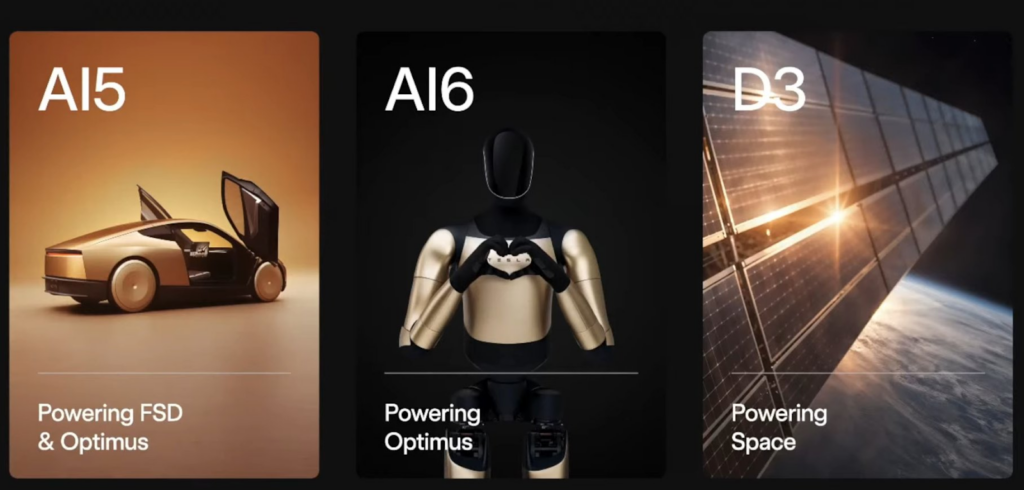
The unofficial conglomerate will pull two families of chips under one roof: the AI5 and 6, for Tesla’s vehicles and Optimus humanoid robots, and the D3: a radiation-hardened chip built for the hostility of space (high-energy ions, photons, electron buildup, and extreme thermal cycling).
Run it Hotter
I know a few things about building systems for space. It is a punishing environment. Every direction you turn, a new constraint wants to kill your mission.
Rather than adapt existing commercial silicon for orbit, SpaceX is instead working towards chips that run at much higher temperatures, which means more efficient heat rejection, which means dramatically lighter radiators. Every kilogram you save changes the entire mission architecture. Anyone who has designed a spacecraft knows what that trade can buy you. As Elon said: “You want to optimize it for space and run it a little hotter than you would normally run a chip on Earth to minimize the radiator mass.” Heat dissipation scales with the fourth power of temperature.
Some 80% of Terafab’s output, according to Elon, will be directed toward space. SpaceX filed with the FCC earlier this year for a license to launch 1M space datacenter satellites. The physics argument is roughly this: the sun hits a solar panel with 5x the energy it gets on the ground, heat rejection is roughly 5x more energy per square meter in orbit than on the ground, and it is far more efficient than on Earth. At the launch costs and timelines the Starship program aspires to reach, Elon optimistically projects that orbital AI compute could undercut terrestrial alternatives on cost within two to three years.
But, again, none of this is what really stopped me in my tracks.
What stopped me cold
What I most admired from Elon’s speech this weekend is discovering that an American group at the cutting-edge of science and technology – an elite team at SpaceX and Tesla – is going back to physics, designing from first principles, and taking on the status quo in semiconductors.
“We’re not just going to do conventional compute,” Elon said. “There’s some very interesting new physics… we’re going to push the limit of physics in compute and try a bunch of wild and crazy things.”
The AI industry is locked into the GPU/CUDA paradigm — a general-purpose architecture originally designed for graphics that accidentally became the workhorse for neural networks. It works, but it’s brute force, power-hungry, and reaching its limits. Musk is gesturing at a very important question: is the GPU actually the right architecture for inference in robots, autonomy and vehicles, and AI in orbit? Or do you go back to the physics and find something better?
And…what possibilities open up when you can make what you design? It has been roughly 30 years since just about anyone in a position of authority seriously proposed building a leading-edge logic foundry in this country. Thirty years. Of course the person who finally did isn’t proposing to copy/paste what already exists, or work off of the same process nodes and same set of instructions as everyone else….
Climbing the Kardashev Scale
By moving this infrastructure off the ground and into orbit, an energy-hungry industry stops competing with communities for power and land. Every town that has watched a datacenter spike residential rates, crowd out other manufacturing projects, or eat open acreage can appreciate what that means.
This vision lights up the inner Kardashev-climbing spirit that has animated me, and I know so many of you, for so long. The sun is 99.8% of all the mass in the solar system, and Earth captures half a billionth of its total energy output. All of human civilization’s electricity production is roughly a trillionth of what the sun puts out. Elon’s point is that scaling civilization means scaling power in space, if it can be safely accomplished. One step closer to the O’Neillian vision, even if it’s not the version O’Neill himself imagined.
The idealist in me — the kid from the Bronx who heard JFK and walked straight into NASA — wants all of this to work. The realist who spent nearly a decade running the agency knows that it might not. Leading-edge fabrication is one of the hardest industrial disciplines on Earth – if not the hardest. TSMC spent decades and hundreds of billions of dollars accumulating the tribal knowledge, supplier relationships, and institutional capacity to print transistors at two nanometers. A single 2nm fab costs $28B and takes years to stand up.
Companies in the Musk Cinematic Universe have designed their own silicon, but none have manufactured a chip. Jensen Huang, who knows this supply chain as well as anyone alive, has publicly said that matching TSMC’s capabilities would be “extremely hard” — that it demands mastering decades of engineering, science, and craftsmanship that brand or money alone cannot buy. But then again, Nvidia has everything to gain by us continuing down our current path.
This is why everyone has taken the easy way out for the last 30 years — designing chips in America and paying someone else to build them. It is the path of least resistance. And it has left us dangerously exposed, with 90% of advanced logic chipmaking on a single island within missile range of the PLA, and dependent, locked into a single wave that everybody rides because nobody wants to be the one to get off. When GPU/CUDA hits its ceiling — and it will — we’ll wish someone had started building alternatives a decade ago.
And yet…
Like Elon, I’ve been on the other side of “this will never work.” I know what it’s like.
The naysayers said Faster Better Cheaper was doomed. That reusable rocketry was impossible. That Commercial Crew would never work. That end-to-end autonomy was a pipe dream. Wrong, every time. Musk has a habit of doing things the experts say cannot be done. The timelines are often off. But the things get done.
Here is how I reconcile the idealist and the realist: even if the orbital datacenter vision doesn’t fully pan out — and that is a high bar, given how much hype has pile-driven into the concept at this point — if Tesla and SpaceX are to take a serious crack at it, the byproducts alone would be worth the effort. A leading-edge American fab! A new compute architecture designed from first principles! Sovereign chip manufacturing capacity for the first time in a generation! Radiation-hardened silicon for national security! If all we “get” out of Terafab is those things, it will have been a tremendously great deal for this country. And if the full vision works — if Musk actually closes the gap between what we have and what we need — then the sustainable abundance he speaks of becomes real, and it fundamentally strengthens our position in the world.
Somebody has to close this gap. If not Tesla and SpaceX, who?
What I’m still wondering and watching
- Will this commitment survive the IPO? SpaceX is targeting a mid-June offering that could raise $50B at a $1.75T valuation. Is Terafab, announced three months prior, merely in service of the IPO roadshow? Will it survive the IPO at this level of ambition?
- Where does the money come from? Tesla’s CFO said the $20-$25B Terafab cost isn’t in the ‘26 budget. Tesla generated $6B in free cash flow last year. So who is cutting the check? (SpaceX’s $50B IPO proceeds may be the answer; we’ll need to see.)
- Can they get the machines? One company on Earth builds all the EUV lithography tools: ASML in the Netherlands. Each costs $200M, and ASML’s backlog is €39B deep. Has SpaceX or Tesla already secured a slot? Or do they want to try to find a workaround to EUV as well? (A topic for another day…)
- Who is it staffed with? Tesla has started recruiting semiconductor process engineers, reportedly targeting 2nm vets in Taiwan. If it’s able to poach a dozen or so high-profile hires here, with deep node experience, we can take it as a massive vote of confidence.
- Where is Terafab sited? The full-scale fab will need thousands of acres and 10+ GW of dedicated power, and probably won’t be able to draw too much from the grid. ERCOT’s total installed capacity is ~105 GW, and the Texas grid is already forecast to fall short of peak demand by next year.
- Will the 80/20 split hold? Elon said 80% of Terafab’s output will go to space and 20% to terrestrial. This will be a critical ratio to watch over time, should all of the other constraints be solved. If the mix quietly drifts toward more chips for cars and fewer for orbit, then it may be that the grand space-based datacenter thesis is sliding.
The Weight of It
Bold, it’s bold. There are no guarantees and lots of questions in my mind. But I was moved.
I’d be doing you all a disservice if I didn’t say this: a technoindustrial enterprise this vertically integrated across energy, transportation, computation, space, and manufacturing raises serious questions that we need to ask. Look to the very first corporation for precedent. The East India Company governed territories, fielded its own army, and controlled trade routes across two continents before anyone with authority could pull it back. I am not predicting that outcome. But when a private enterprise begins to shape the infrastructure of a nation — potentially, of a civilization — the American public needs to be aware and in the room, not asleep at the wheel or watching from the stands.
I spend my days in conversation with folks who want to rebuild America’s supply chain to look more like Shenzhen – to close the distance between what we invent and what we can actually build. Maybe Musk’s approach is a different answer to the same problem. Maybe it’s the answer. I don’t know yet. But the American public and its government need to be paying serious attention.
The Terafab team has taken on a vision unlike anything this country has seen in recent memory, with enormous responsibility in their hands. These are, simply put, the hard things.
🇺🇸🫡✨
Dan Goldin