
In American Dreams (Issue #022), we wrote about our once-in-a-generation construction supercycle, largely driven by hyperscalers, who will spend $320B+ on datacenters this year. But we noted that the supercycle reaches far beyond hyperscalers, GPU designers, or frontier model labs — up, down, and across the industrial economy. We already named two second-order winners in Issue #025: the “aircraft boneyard raiders” (e.g., clever aircraft turbine retrofitters) and Caterpillar. Now, it’s time to nominate a third: the skilled trades..
“I pinch myself going to work every day.”
That’s 51-year-old contractor DeMond Chambliss telling the WSJ about his night shift overseeing 200 welders, plumbers, and electricians at a DC build in Columbus, OH. DeMond traded his small drywall business for a supervisor role and now pulls in $100K+ annually. He’s not alone: workers moving into datacenter construction are seeing pay jumps of 25-30%. The money’s great because an all-out arms race to bring new gigawatts online is colliding with a supply-constrained skilled trades market. (Case in point: Becoming a licensed electrician takes 4-5 years; 45-70% of DC construction is electrical work; and 30% of union electricians are near retirement age.)
Skilled tradesmen are the long pole in the tent on every project, so developers are throwing money at the problem and often resorting to extreme measures, such as flying around staff on private jets and setting up “man camps” at remote builds in the Texas Panhandle and the Dakotas. (Man camps = temporary villages that house crews, with dorms, mess hauls, laundry, and full sewer systems.)
Five years ago, you’d start building the second structure on a campus after finishing the first. Now, you build all eight structures simultaneously, run 24-hour shifts, pay overtime, and if necessary, fly trainers around on Gulfstreams.
The Per Aspera POV
The software abstractors have turned into high priests of heavy industry. Under their new industrial logic, competitive advantage comes from building in the real world faster than your rivals. In this game, players are motivated by a mix of paranoia, prisoner’s dilemma, and profit maximilization, and the risk of waiting exceeds the risk of waste. There are certainly critiques one could make about the shape and texture of this renaissance: maybe it’s (A) crowding out other manufacturing, (B) inflationary for inputs for other critical sectors, and (C) the most expensive game of corporate follow-the-leader. But…you wanted an industrial renaissance? You’ve got one, and it’s undeniably reshaping the topology of an entire continent — and crowning new winners in the process.
Breaking/Bonus: A fourth nominee!
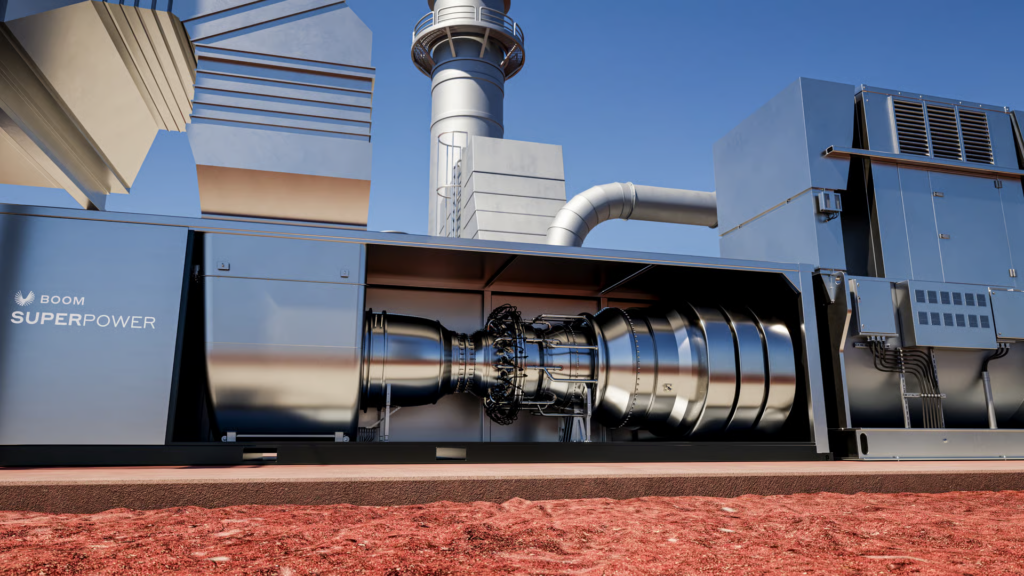
While putting the final touches on today’s issue, we saw news from Blake Scholl and Boom Supersonic, which has raised a fresh $300M round. But that’s not the real news. Boom also announced its second product and it’s not another supersonic airliner. It’s Superpower, a 42 MW natural gas turbine optimized for AI datacenters. Crusoe has signed on as a launch customer, placing a 1.21 GW order. The turbines are expected to start entering service in 2027.