
Introduction
The Situation
If you’re anything like us, you’re stealing a few minutes from an already overdrawn day to find more updates on the situation in the Middle East. And in an unfortunate but entirely predictable turn, most of what you’ll see online is obsessively fixated on one narrow slice of a much bigger fight: interceptor/attacker asymmetries. The viral version goes something like ‘the U.S. and her allies are using $4M Patriot missiles to swat down $10,000 Iranian drones!!!’ The expensive interceptor bad, cheap drone good meme is like a saturation attack on our timelines, mainstream media stories, and public discourse, which ultimately serves as a distraction for the nation, its industrial base, and our strategic planners. We think there’s a more productive conversation to be had here, and it starts with the peculiar industrial history of the drone at the center of this conflict — one that reads like it’s straight out of a le Carré novel.
The Cold War Concept That Wouldn’t Die
In the 1980s, the West Germans (Dornier GmbH) and Americans (Texas Instruments) had partnered to develop a disposable anti-radar drone called the DAR. Die Drohne Antiradar was a cheap, single-use system that could loiter over Soviet radar sites and dive into them. Standard Cold War Stuff. Only the war ended, the Germans shelved DAR, and the concept scattered into the post-1989 arms bazaar. What came next is difficult to definitively trace. South Africa’s Kentron developed its own version around the same time. The Germans reportedly sold DAR technical documentation to Israel, but so did Kentron. Israel used what it had to create Harpy, a one-way, radar-seeking drone, which would go on to become one of the more consequential arms exports of the era. Harpy was sold to South Korea, India, and, fatefully, China, for ~$55M (that last one was not taken kindly in Washington, and when Israel tried to upgrade the Chinese Harpys a decade later, it was frozen out of the F-35 program until the dispute was resolved).
The Story of the Shahed
Iran was watching Harpy’s arc closely. Sanctions had frozen it out of the global arms market, but the underlying designs were for sale if you knew where to look. Iranian engineers bought drone documentation from Kentron, reverse-engineered a German piston motor, and sourced civilian avionics from commercial supply chains. The smaller Shahed-131 came first in 2015. The larger Shahed-136 followed, unveiled publicly in December 2021 with a delta wing, a ~50kg warhead, and a unit cost that made mass production trivial. Each part was either commercially available or simple enough to manufacture domestically under sanctions. The airframe – a composite cloth over a honeycomb core – “could effectively be manufactured by any DIY handyman,” a think tank dryly noted.
The key point: this could be built in enormous quantities by people without access to sophisticated anything.
A Drone Spreads Its Delta Wings
In August 2022, a Russian military cargo plane landed in Tehran carrying €140M in cash and a consignment of captured Western weapons. It left with 166 drones, 100 of them Shahed-136s. Moscow rebranded them as the Geran-2 and started launching them at Ukrainian power infrastructure that fall. Within months, Russia signed a $1.75B deal to build its own. The initial production run called for 6,000 drones by September 2025, a target it beat ahead of schedule. Each batch came off the line a little different: GLONASS replaced GPS, new warhead variants were added (thermobaric, fragmentation, incendiary), and matte black coatings were applied for radar-absorbing night sorties. Today, Russia has the capacity to make ~60,000 Shahed-type drones (10x initial target) if the lines were to run flat-out.
The Shahed was also “exported” to an extremist group in one of the poorest countries on Earth. Shahed-like drones had first appeared in the Arabian Peninsula by 2019, and in the years that followed, the Houthis graduated from importing finished weapons to making their own. Interdictions at the Port of Aden last year – 58 containers, 2,500+ tons – revealed lathes, presses, jet engines, electronic control systems, and factory equipment flowing into Yemen from a dual-use China pipeline. The Houthis, it turns out, fabricate fuselages, formulate propellant, and pack explosives across a distributed in-country network, mating domestically produced parts with imported Iranian guidance kits. This is a production network that is hard to entirely stamp out, and it’s the very supply chain that shut down Red Sea shipping and put commercial vessels under sustained drone attack for well over a year…mind you, built in one of the most impoverished countries on Earth, under an international arms embargo, with hardware you could order from a catalog.
The Cat-and-Mouse Nature of Drone/Counterdrone
By early 2026, Russia had fully localized Shahed production. The Alabuga plant in Tatarstan — built from scratch in a special economic zone — now manufactures engines, airframes, carbon-fiber fuselages, and electronics domestically, churning out an estimated 4,000-5,000 units per month. Western intelligence officials told CNN that the scale of Russia’s buildout has surprised even Tehran and represents “a gradual erosion of Iran’s control over the final product.” The student, in other words, no longer needs the teacher, and may soon be in a position to supply updated, combat-proven drones back to Iran to replenish stocks depleted by U.S. strikes.
And product iteration continues apace. There’s the Geran-1, based on the Shahed-131, and the Geran-2, which has flown 57,000 sorties against Ukraine since 2022. Russia’s Geran-3, a jet-powered derivative based on Iran’s Shahed-238, swaps the 136’s lawn-mower propeller for a turbojet, pushing cruise speeds above 300 km/h and compressing the interception window that Ukraine had learned to exploit A newer Geran-4, downed over Ukraine in January, was faster still: 500 km/h, with an R-60 air-to-air missile strapped to its belly, designed to shoot back at the interceptor drones chasing it. Ukraine is adapting, with its Sting interceptor scoring the first jet-Shahed kills in late 2026. But so is Russia.
This is the nature of the game now: a grinding, iterative cat-and-mouse cycle between mass-produced attack drones and mass-produced countermeasures, with each side racing to field the next increment faster than the other can respond.
One-Way System Completes Round-Trip Journey
Last Saturday, the chain completed its most improbable leg yet, when CENTCOM confirmed the first combat use of LUCAS – the Low-Cost Unmanned Combat Attack System — over Iran during Operation Epic Fury. LUCAS is built by SpektreWorks, a bootstrapped, ~15-person small business in Arizona that got its start making Shahed replicas for U.S. air defense training. The U.S. captured a real Shahed, stripped it, reverse-engineered the airframe, added swarming capability and comms gear (Starshield/Starlink) the original never carried, and put it into combat eight months after its first public showing in the Pentagon courtyard.
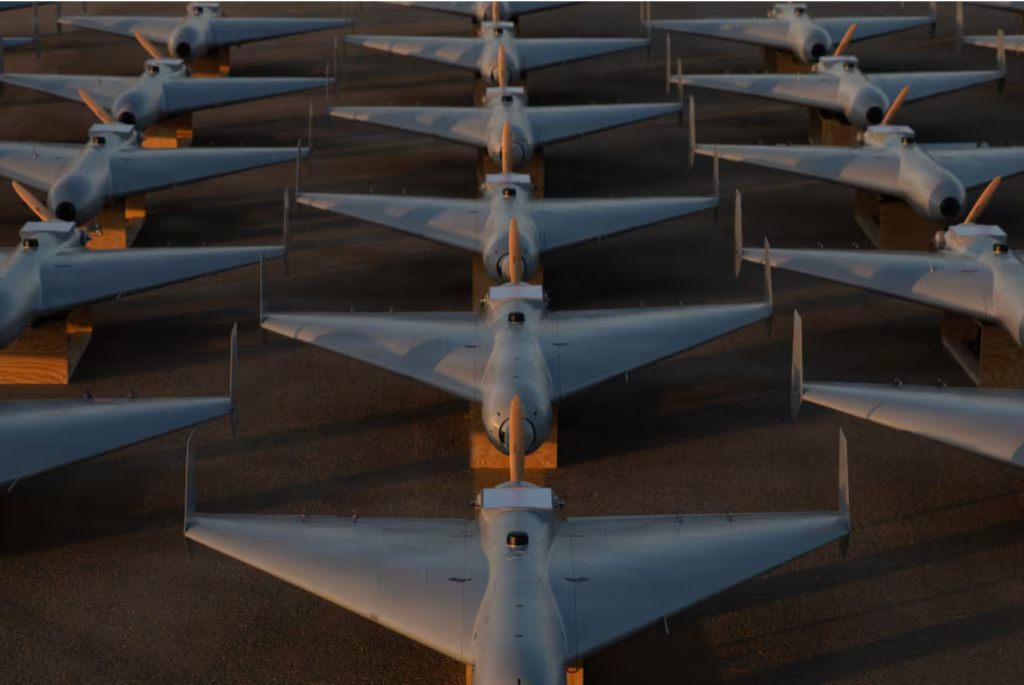
LUCAS drones positioned in U.S. Central Command. (via DOW)
At ~$35,000 a round, LUCAS occupies the opposite end of the cost curve from the systems designed to intercept drones like it. And, revisiting the cost-exchange discourse, because the internet can’t help itself: for goodness sake, nobody is shooting $28M SM-3s at Shaheds. SM-3s intercept ballistic missiles in the exoatmosphere, a completely different weapon for a completely different threat. Drones are engaged with a layered mix of missiles, guns, EW, decoys, and increasingly lower-price-per-shot interceptors (e.g. directed energy). The Pentagon’s posture isn’t, and never was, to hide behind a 21st-century Maginot Line while air-defense magazines run dry. It is to suppress launch rates upstream – which is working – and defeat what gets through at the lowest feasible cost per shot. The peanut gallery seems unwilling to acknowledge this.
Seven (early) lessons to take home
- F-35s and Shaheds aren’t competing for the same job. Stealth aircraft, carrier strike groups, space architectures, and the rest of the high-end (and very expensive) toolkit still underwrites deterrence and delivers overmatch (as it is doing, right now, over Iran). Exquisite engineering affords capability that is too complex and costly for an adversary to replicate. They simply cannot build it.
- Cannot build cuts both ways. The military needs both tiers – the exquisite and the expendable – and the harder question is whether we can produce enough of either fast enough. The industrial base is the bottleneck (which shouldn’t come as a surprise to anyone here).
- “The factory is the product.” If you squint hard enough, this Elon-ism – a fan favorite in the hard tech world – looks a lot like Pershing’s line: infantry wins battles, logistics wins wars. The Shahed is a DFM (design for manufacturability) story, born of sanctions and desperation, optimized for producibility above all else. That’s what made it one of the most proliferative systems in modern history. And it marks a wider turn that goes well beyond one drone…
- …precision has flown the coop. Since Desert Storm, precision has been scarce, expensive, and almost always exclusively ours. No longer. Cheap precision now arrives by the hundreds or thousands at commodity prices, with a few short hops to spin up your own assembly line. We must get comfortable with this new reality rather than wishing it weren’t so, and focus our creative energies on containing/channeling/countering this permanent change across land, air, sea, and subsurface domains.
- The interceptor math is solvable. Raw necessity and Darwinian competitive forces have a way of producing answers that peacetime planning rarely does. Exhibit A is Ukraine, which has met mass with mass. Last month, Kyiv said it successfully intercepted 3,238 Shaheds, using interceptor drones at $3,000-$5,000 apiece for 1,500+ of those kills (back of the napkin, $5M-$8M in interceptor costs to destroy $30M-$75M worth of Russian attack drone).
- We are not asleep at the wheel. The Shahed took something like 400 months to travel from a German drafting table to Iranian airspace. LUCAS, which took ~8 months, is a case study in bypassing bureaucratic cruft and traditional channels when they no longer serve, and shipping a “good enough” solution, rather than spinning the wheels on an over-engineered product that arrives years too late.
- It’s time to go Faster, Better, Cheaper. A small American business, SOCOM, and CENTCOM brought a new system to the battlefield in record time. The Drone Dominance program, discussed last week, is an effort to do the same at a much greater scale, with unit prices stepping down as volume rises and vendors must compete on cost, performance, and learning rates. We have multiple programs underway across other critical industries to do the same thing. This is the tempo we need. It’s Faster, Better, Cheaper. What the U.S. lacks in near-term productive capacity we more than make up for in high-agency, entrepreneurial culture, scientific capacity, engineering depth, capital markets, alliance networks, and a national habit of figuring things out when it counts.