
In 1991, a metallurgist at the Welding Institute in Cambridge, England, filed a patent for a process that sounded like it shouldn’t work. The process either violated the foundational logic of welding or simply completed it, depending on your perspective: press a rotating tool into the seam between two metal plates, generate enough frictional heat to soften the metal without melting it, and stir the joint together in solid state. With this heat process, the welds came out stronger than fusion joints. Wayne Thomas called it friction stir welding.
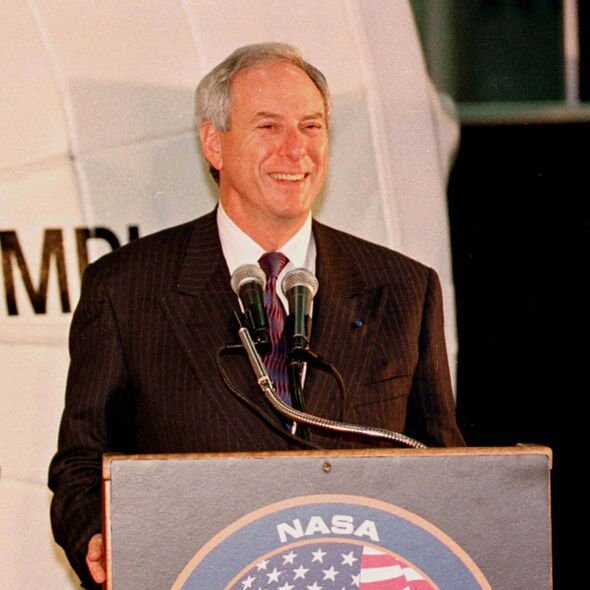
A year after Wayne filed this patent, I became NASA Administrator. Neither of us knew it yet, but Wayne’s patent was about to save my space station.
Here was the problem
In 1993, the United States and Russia agreed to build the International Space Station together. The deal put the station in an orbit inclined at 51.6 degrees – the angle that let the Soyuz and Proton spaceships launch from Baikonur Cosmodrome in Kazakhstan. But the Space Shuttle had been designed to reach a 28.5-degree orbit from Kennedy Space Center.
Forced to the higher inclination, it lost ~11,000 pounds of payload capacity per flight. The Shuttle had to lift the components to assemble the station.
Without those 11,000 pounds, it could not do the job.
So how was I feeling?
“I was shi*ting in my pants.”
We looked at every propulsion option on the table.
Adding a fourth main engine to the Shuttle, or upgrading the thrust of the existing three RS-25 engines, would have required fundamental redesign of the Orbiter’s aft structure and propulsion system. This would have added a development timeline of three to five years and many billions of dollars – a programmatic and political nonstarter.
A second option, to stretch the External Tank to carry more propellant, was similarly constrained by the Orbiter’s geometry and the American launchpad infrastructure (going from Kennedy Space Center). Enhanced solid rocket boosters were another option, but carried the same long timelines and high costs.
So, instead, we went after the weight. Our target was the External Tank, the large central vessel that feeds propellant to the main engines during ascent.
The material that could save the station
In 1993, the NASA Marshall team challenged Lockheed Martin Laboratories in Baltimore to find a high-strength, low-density replacement for the aluminum-copper alloy 2219 used in the original tank.
Working together, Lockheed Martin, Reynolds Aluminum, and the engineers at Marshall Space Flight Center developed aluminum-lithium alloy 2195 — a material from the Weldalite family that Lockheed Martin had helped pioneer. It is 30% stronger and 5% less dense than 2219, and it was engineered to withstand cryogenic temperatures as low as minus 423 degrees Fahrenheit, the temperature at which liquid hydrogen is stored.
Because the External Tank reaches near-orbital velocity with the Orbiter at main engine cutoff, every pound removed from the tank translates almost directly into one additional pound of payload delivered to orbit. I was shooting to recover 11,000 pounds. The program delivered 7,500 pounds of weight reduction per flight. Against a total payload capacity of roughly 30,000 pounds to the station orbit, that margin made assembly physically executable.
The alloy we needed couldn’t be welded.
For all of its strengths, 2195 posed a critical challenge: it couldn’t be conventionally welded!
Conventional fusion welding, in which an arc melts the base metal and the joint forms as the material resolidifies, produced hot cracking and porosity in 2195 at rates that made it unusable. (Hot cracking = fracture along grain boundaries during solidification. Porosity = gas voids trapped in the resolidified material.) The alloy the station structurally required could not be reliably joined by the only welding process we had.
Friction stir welding (FSW) resolved the incompatibility directly. Because the process operates in solid state — the metal softens under frictional heat but never reaches its melting point — it eliminates the solidification-phase defects that disqualified 2195 under fusion welding.
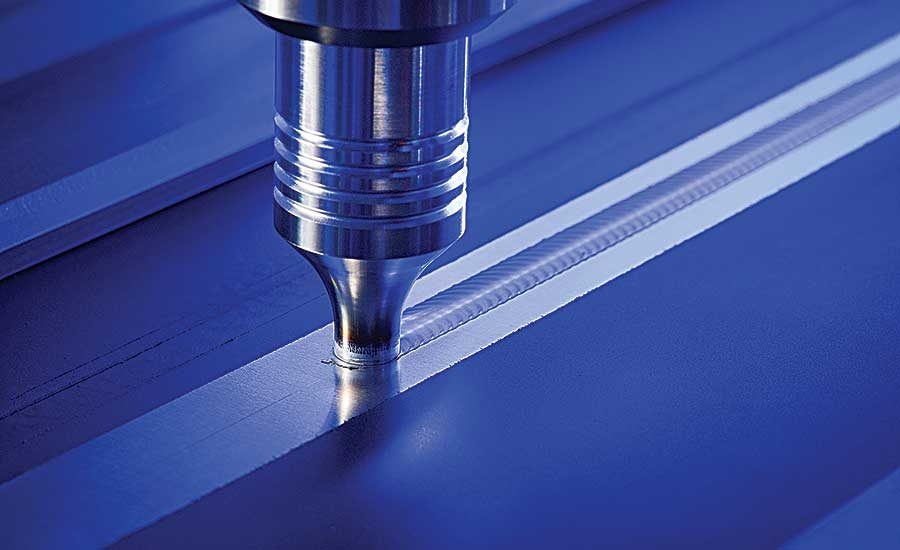
This process, for all of my physics lovers, is governed by three variables: the rotation speed of the tool, the travel speed along the seam, and downward pressure. We started looking at FSW for the External Tank in 1994 and flew the first FSW-produced flight hardware in 2001. Each completed tank contained approximately 700 linear feet of friction stir welds.
Total development cost for the Super Lightweight Tank program was ~$172M. The propulsion alternative would have been in the billions.
Lockheed Martin Michoud Space Systems had to overcome significant production tooling challenges to get there — the tooling and fixturing required to hold large cryogenic tank structures in position while a friction stir tool traversed hundreds of linear feet of weld seam at precise loads — but the production process they developed held.
Bringing it back down to Earth
The Space Shuttle flew more than 100 missions on External Tanks joined with friction stir welds and recorded zero friction stir weld-related failures across that entire flight history. FSW was demonstrated on the most safety-critical human-rated application in the history of manufacturing, with complete public accountability for every flight outcome.
The process knowledge we developed at Marshall, Michoud, and with Lockheed Martin proliferated to other space systems, beyond NASA and into New Space (SpaceX uses FSW in Falcon 9 production).
The Welding Institute has issued more than 200 licenses across 24 countries. Norwegian and European commercial shipyards have run the process for three decades on aluminum hull panels and superstructures. Automotive manufacturers building EV battery enclosures absorbed it into high-volume robotic production lines.
The hard problem NASA was forced to solve under schedule pressure, with the fate of a space station hanging in the balance and lives at stake, produced a solution that works extraordinarily well everywhere aluminum is joined.
I had the privilege of leading this agency for ten years. As Administrator, I got involved in the technical details, which was the fun part. And this was one that always stays with me: A metallurgist in Cambridge filed a patent that nobody in Washington had heard of. A diplomatic agreement between two former Cold War adversaries created an engineering crisis that threatened to kill the space station before it was built. And a team of engineers at Marshall, Michoud, and Lockheed Martin found a material that could resolve the crisis, found a process that could join the material, and flew it 100+ times without a single failure.
Not to put too fine a point on it, and pardon my French, but the goddamn thing works. It works in rockets, it works in car factories, it works in shipyards. More industries should be using it!
Many decades after competition of the super lightweight tank I sought assistance from NASA leadership to identify the brilliant engineers who contributed to this activity. Their names are listed below. If I missed any names please accept my apology. I wish to thank Hansel D.V. Gill Director of NASA Michoud for his assistance and leadership seeking to identifying the talented engineers and scientists who brought the Aluminium Lithium Friction Stir Welded Super lightweight tank to fruition.
NASA
- Kirby Lawless, Welding Engineer
- Pat Rogers, Stress Engineer
- Julian Bynum, Metallic Materials Eng
- Preston McGill, Metallic Materials Eng
- Po Chen, Metallic Materials Eng
- Ronnie Renfroe, Welder
- Paul Munafo, M&P Lab Manager
- Fred Bickley, Materials Eng
- Neil Otte, Stress Engineer
- Rob Wingate, Stress Engineer
- Doug Wells, Metallic Materials Eng
- Sherman Avans, ET project office
- Chip Jones, Weld Controls Engineer
Lockheed Martin Corp.
- Sandeep Shah, Metallic Materials Eng
- Bill McGee, Weld Engineer
- Dan Rybicki, Weld Engineer
- Norm Elfer, Metallic Materials Eng
- Mike Quiggle, Chief Engineer
- Jeff Pilet, Stress Engineer
- Michelle Worden, Weld Engineer
- Jerry Majors, Weld Engineer
- Alex Kooney, Weld Engineer
- Fred Ogden, Weld Engineer