
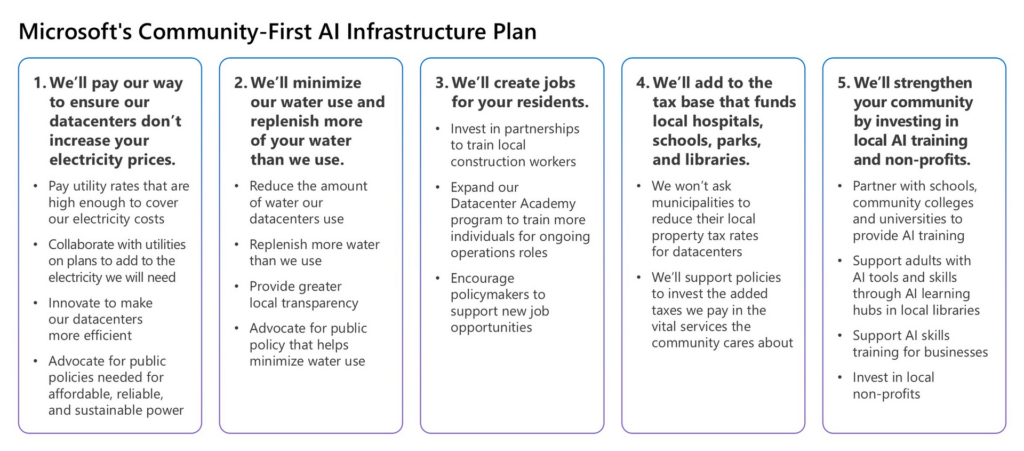
Microsoft has published the closest thing that hyperscalers have to a détente strategy. Yesterday, Microsoft’s Brad Smith announced the company’s “Community-First AI Infrastructure Initiative,” a five-point framework pledging to:
- Pay its own way on electricity so datacenters don’t raise residential power bills
- Use closed-loop cooling and replenish more water to local watersheds than it uses
- Train and hire local workers for permanent positions
- Contribute to the tax base without seeking excessive abatements
- Provide free AI training via “anchor institutions”
Why Now
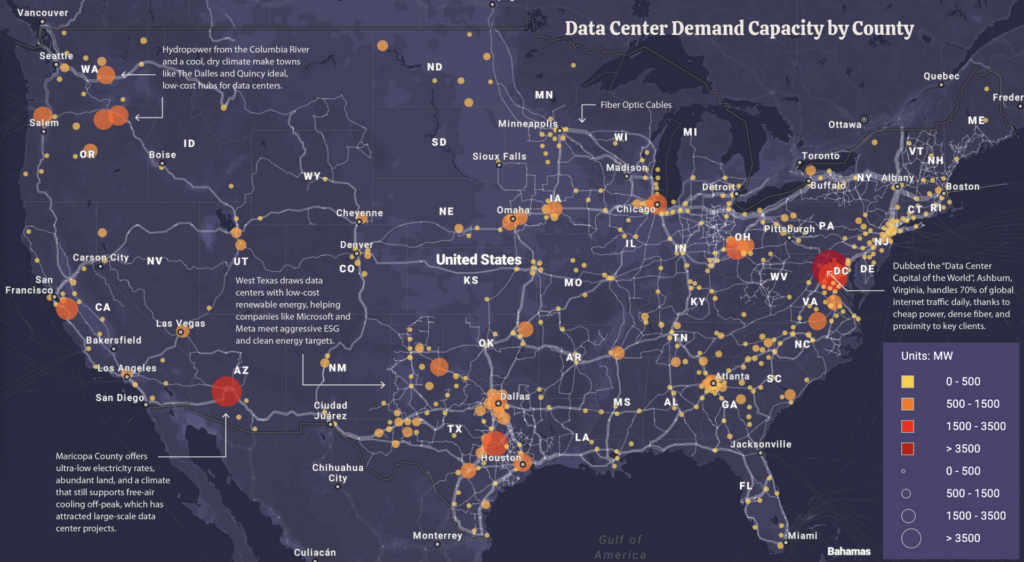
The breakneck buildout of datacenters, and the metastasizing opposition to such projects, were both defining stories of 2025.
- Project cancellations due to local backlash quadrupled year-over-year, with at least 25 projects worth 4.7 GW killed in 2025 alone. Another 99 are contested nationwide out of the ~770 planned.
- In one high-profile incident, as noted in Per Aspera #019, Google withdrew a 468-acre, $1B+ project in Indiana minutes before a city council vote, amid backlash over jobs, water, and taxes.
- Virginia, host to 30-40% of all U.S. datacenter capacity, is political ground zero. In a recent race, county supervisor candidates from both parties voiced concern about future datacenter development.
Making the Gains Legible
The democratic legitimacy issue with AI infrastructure often stems from communities feeling ambushed rather than consulted. Developers arrive via shell corporations, secure approvals under NDAs, extract massive tax abatements, and saddle regions with grid upgrades and residential power rate hikes. Or, at least, that’s the perception shaping local politics.
Here is the paradox: datacenter development & energy infrastructure can create genuine economic value. But if the gains accrue invisibly to distant shareholders while costs land locally — or, if this is perceived to be the case — communities will increasingly question and/or reject the project.
Ultimately, we see this as savvy politicking from Microsoft: not only in its attempt to deliver more widespread, good-faith gains, but also by making them legible to local communities. The messenger matters, too, as it’s coming from the top: Brad Smith, vice chair and president of Microsoft, has spent the better part of two decades working to transform the firm from antitrust pariah into the rare Big Tech company that politicians, regulators, and power brokers in DC (and Brussels) will play ball with.
The White House signaled its support for Microsoft’s initiative, a marker of how national this issue has become. Already, both Silicon Valley and Washington are bracing for datacenter/AI politics as a 2028 election cycle issue. If Microsoft walks the walk, and this becomes the industry floor rather than a PR ceiling, it may help hyperscalers achieve the social license they so desperately need.
Or, maybe datacenters will just migrate to space…