The strangest thing about Taiwan
The strangest thing about Taiwan is how often it appears in American discourse, and how rarely Americans appear there.
The island comes up whenever anyone wants to sound serious about semiconductors, the Indo-Pacific, or the future of AI. Taiwan comes pre-loaded with its own American-developed vernacular: the Davidson Window, Silicon Shield, Porcupine Strategy. When the U.S./Iran war started this year, many commentators asked: Okay, but what does this mean for Taiwan?
And yet precious few of us have actually been.
America’s ruling class thinks about Taiwan. Big Tech thinks about Taiwan. Frontier lab founders think about Taiwan. And so, naturally, do the professional situation-monitorers LARPing their way through it on LinkedIn, X dot com, or their geopolitics Substack (oh, the irony). This persecuted class is convinced history is finally calling for their comment. Unlike uniformed Pentagon brass, the intelligence community, congressional staffers, or technology executives, they do not control any meaningful lever. They are, however, very determined to be seen gripping one.
For half a decade, I was in the same boat: 8,000 miles away, fixated on the island, producing what were surely very original thoughts about things like “concentration risk with Chinese characteristics.” Fine. Guilty. I was an armchair-analyzing Taiwan theorycrafter from afar.
The first step is admitting you have a problem. The second is realizing how few of us have gone to the place, met its people, and reverse-walked the supply chain that, for any finished system — fighter jet, server rack, iPhone — starts on an island the size of Maryland, sitting in one of the most contested maritime corridors on Earth.
This April, I finally broke the curse and went.


Schrödinger’s State
If you go to Taiwan — and if you write about it, craft policy around it, invest downstream of it, or build a company whose existence depends on it, you really should — your journey starts with a contradiction.
You fly commercial, land in Taoyuan, and clear customs, where your passport is stamped by a government the United States of America does not formally recognize as sovereign. America’s de facto embassy here is not an embassy. It’s the American Institute in Taiwan (AIT): a Washington-funded nonprofit whose staff are technically private citizens on leave from the State Department.

For an entity we do not legally recognize, we sure do a lot of business with Taiwan, one of our largest trading partners. Last year, for the first time since 1999, the U.S. overtook mainland China as Taiwan’s largest export market, absorbing 31% of what the island shipped abroad. Goods trade hit a record $256.1B, with American imports from Taiwan surging 73% year over year, driven by the AI supercycle.
Though we don’t recognize Taiwan as a country, we are the only outside power willing to arm it at a meaningful scale. Last December, the White House notified Congress of $11B in new Foreign Military Sales to Taiwan, the largest package in dollar terms ever, bringing the total U.S. arms sales backlog to ~$32B.
So: we do not recognize it, but we depend on it. And it certainly depends on us. Such are the contradictions of this island that might, pound for pound, be the most economically important place in the world.
The air is thick with industrial competence
You can get a sense of this from afar, but even before the humidity, the first thing that washes over you when you step out into Taipei is the industrial competence.
There’s no substitute for seeing it firsthand: the pride with which national champions like Taiwan Semi and Foxconn come up in conversation with taxi drivers, executives, legislators, and military officers. Semiconductors may be the main character, but there’s a shared reverence for the whole cast. Around the foundries and packagers sits a dense torso of suppliers, assemblers, and precision machinists, and a long tail of mom-and-pop SMB manufacturers.
In technical and business meetings, a conversation can move from RF modules to photonics benches to compound-semi packaging to autonomy testbeds without anyone losing the thread. Present company sometimes excepted.
Decades of tribal knowledge have accumulated here. Most of it sits under lock and key, but key principles are dispensed freely. One bit of advice that I, and every technology developer visiting the island, receives early, often, and unprompted: You need to do DFM.
For me, it all came to a head while walking the halls of ITRI, the state-backed research institute that spun out a little manufacturer called TSMC in 1987.
The Cassandra Moment
Per Aspera’s connectionto Taiwan predates our not-quite-one-year-old publication by 36 years.
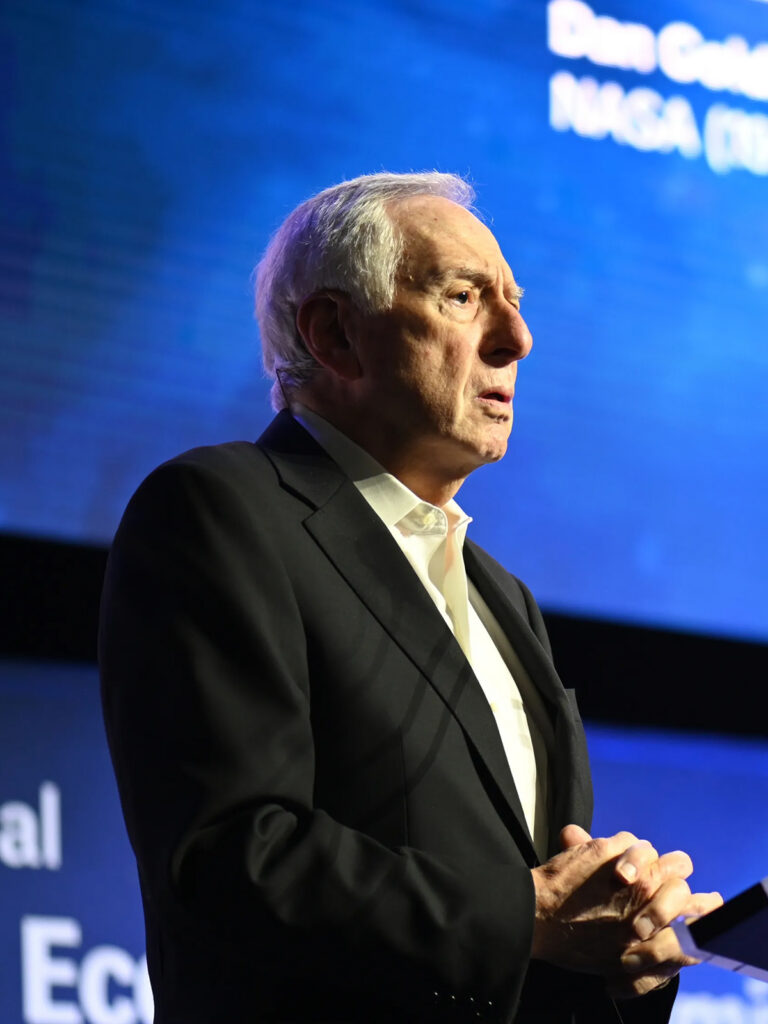
In 1990, my cofounder Dan Goldin – who will, unprompted, walk you through the romance of gallium arsenide, gallium nitride and the wonders of CMOS – started hearing rumblings that something was happening in Taiwan led by a US expatriate named Morris Chang, and that he *had* to go see what was happening.
So Dan went to pay Morris Chang a visit.
Chang had been passed up for the top job at Texas Instruments, and had returned to Taiwan in 1985 at the government’s request to run the Industrial Technology Research Institute (ITRI), then best known for having licensed an obsolete 7-micron process from a retreating RCA. In 1987, Chang spun a company out and stood up his first production line inside a repurposed ITRI building.
The premise was unheard of: a pure-play foundry, manufacturing for anyone and designing for no one. Before the doors opened, Chang flew around the world asking Intel, TI, Motorola, AMD, Panasonic, and Sony to take an anchor stake. All six declined. A Dutch company called Philips said yes, and with that, Taiwan Semiconductor Manufacturing Company opened for business.
By 1990, TSMC was the age of a toddler. Dan was running TRW’s Space & Technology Group, which is to say, he was leading his team in custom designing, buying and building the rad-hardened silicon for national security space systems. He had access to the company’s own 100,000-sq. ft. advanced semiconductor fab in Manhattan Beach, California, and likes to say that they designed and built satellites from the unique semiconductors they developed on up the system. He knew enough about what fabs could and could not do.
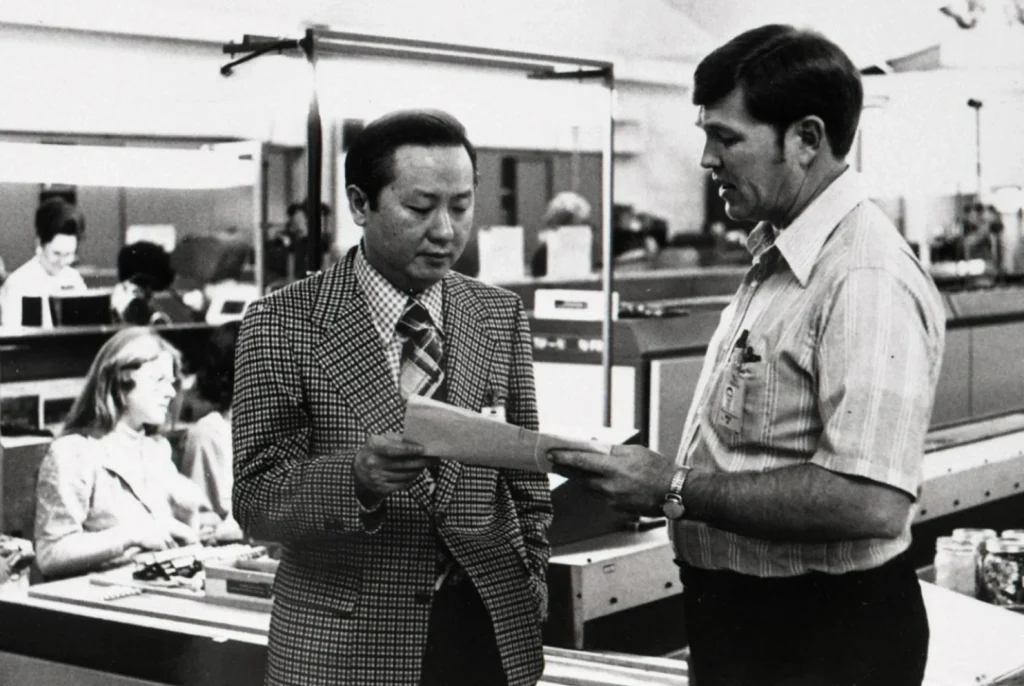
“Nobody gave a damn what Morris Chang was doing!”
Here is what he saw on his first trip, three or four years into TSMC’s young life:
Morris was playing a different sport with the fabless model. He was going after economies of scale in a way that nobody had really tried. Even in those early days, I could see a tsunami coming.
I wasn't quite at the point of hysteria but I was terribly impressed.

Four years later, Dan had become the boss of NASA. America’s space agency had been asked to do more with less. Contracts were being opened up and he was worried about his supplier base. So he went back to Taiwan to pay Morris Chang a second visit:
Morris walked me through again and it was a highly sophisticated operation. I saw that they were going to pull ahead.
I went to the House, the Senate, and the White House and tried to tell people. I called up Andy Grove at Intel. I couldn’t get anyone interested!
The industry was doing well. By then, Intel was doing some business with Morris on older product lines to free up capacity for more advanced products. The appetite to change course wasn’t there. The policy side didn’t know the technology well enough to be scared.
Dan “Cassandra” Goldin was right: For TSMC, the coups kept coming, and they didn’t stop coming.
The fabless paradigm that Chang had predicted, and engineered TSMC to serve, would indeed eat the world. Nvidia leaned on TSMC for GeForce starting in the late ‘90s and, aside from a few Samsung detours, has lived at Hsinchu ever since. AMD spun out its fabs into what became GlobalFoundries in 2009 (IBM wouldn’t hand off its own fabs to GF until 2015). Apple moved A-series production to TSMC in 2014 and soon made it the sole supplier of its high-volume iPhone application processors. Qualcomm, Broadcom, MediaTek, Marvell, and a long tail of specialty silicon designers followed the same playbook, routing their leading-edge volume through Hsinchu as the fabless model became the default way to build competitive chips.
The breakaway moment came in 2018, when GlobalFoundries killed its 7nm program. Any designer that wanted a competitive leading-edge node had to take the Hsinchu road.
By the late 2010s, TSMC had pulled ahead of Intel. Grove’s successors were less disciplined and less paranoid, which is the politest way to describe a management culture that spent ~$128B in buybacks between 2001 and 2020, while TSMC plowed nearly every dollar of free cash flow back into capex.
Intel itself was a major TSMC customer by 2024, contracting the compute tile of its own Arrow Lake flagship to N3 in Hsinchu.
A concentration risk with Chinese characteristics
Western dialogues around Taiwan tend to flatten the island into a single variable: the fabs. My fascination with Taiwan goes back half a decade, to a oh-sh*t moment, a Covid rabbit hole, and a length 2021 article I wrote about the concentration of advanced logic chip-making in Taiwan. I wasn’t wrong, but I was working off of a hopelessly incomplete picture. Because while we all tend to pantomime about the shiny thing (semiconductors), Taiwan has formidable global share across a whole lot more:
The weather
By this point you may be wondering what any of this has to do with why I was on the island instead of crafting pet theories from 8,000 miles away.
I was in Taiwan representing my company, Array Labs, on a maritime security delegation organized by a trade group called UPIA. The delegation consisted of a dozen founders and executives meeting over the course of a week with Taiwanese legislators, generals, admirals, research institutes, and suppliers.

Nearly every American company in the delegation was building some flavor of unmanned surface or subsurface systems: products with very obvious PMF in a country that is, quite literally, ringed in by its problem set. I was the odd duck of this lot: a space-based sensing company, offering the best orbital radars money can buy, amongst a group of blue-sea builders. Not as odd as it sounds. To secure the seas, you need wide-area, all-weather maritime domain awareness, and radar from orbit can help against clouds, darkness, distance, or “area denial,” but that’s a story for another day…
The delegation was not a moment too soon. Taiwan’s next‑door neighbor has the largest navy in the world and it’s only getting larger. Taipei, like everyone else, is urgently trying to figure out its unmanned strategy for this brave new age.
After a few days of briefings, the analogy that lodged itself in my head was weather.
That is how senior Taiwanese figures – legislators, retired flag officers, commanders – actually talk about the People’s Republic of China. They do not say Beijing, Xi, PLA, or PRC in every other breath. They refer to the aggressor, cross-Strait pressure, the operating environment, and defensive precautions. Then they explain what they are doing to live inside the situation.
It is a far cry from the sweeping rhetoric in Washington about containing a near-peer power, or the curated snippets you’d get from the swanky global security conference circuit, where danger is abstracted into theory. Here in Taiwan, theory is only useful insofar as it can be applied to a plan in the present.
It’s like a coastal town talking about hurricane season. You do not debate a hurricane’s existence, question its intentions, or try to persuade it not to make landfall. You prepare, stockpile, retrofit, study the last one, and plan for an even bigger one.
The Two Shields
Two theoretical shields stand between Taiwan and the scenarios it plans against.
The first is economic. The silicon shield holds that Taiwan is too foundationally integrated into the global economy, and too economically critical, to invade. Destroy, damage, or even interrupt the fabs for long enough, and you risk a global depression, the likes of which we have not seen in our lifetimes. There is no romanticism here about democracies rushing to the defense of their fellow like-minded, self-governed societies. This theory, rooted in the crude calculus of realpolitik, simply stipulates that the world will not let Taiwan fail because it cannot afford to.
But even the armchair guys can sketch up scenarios where this deterrent fails. Pick your poison: China cracks EUV or a viable alternate tech tree; enough TSMC fabs and tribal knowledge copy-pasted abroad to dull the dependence; or PLA planners convince themselves that the long-run strategic payoff is positive-EV, even with damaged/destroyed fabs and near-term economic shock.
This shield is not a force field, and one should always make contingencies.
Western narratives tend to fixate on the darkest version of a potential kinetic confrontation: the full‑on, Normandy‑style amphibious invasion. In Taipei, we heard more granular, nuanced views. One senior official walked us through, quite persuasively, why that scenario would be very difficult. The Taiwan Strait – the Black Ditch, as old mariners called it – is shallow, treacherous, and workable for an invading armada only during narrow seasonal windows. The island offers few viable landing beaches, each presumably pre-sighted by Taiwanese artillery, mined, and backed immediately by mountain or dense urban cores.
Reasonable minds disagree. Western analysts, not of the armchair variety, counter that the PLA has spent two decades investing in and iterating on roll-on/roll-off conversions, floating causeways, and coastal assault doctrine. Just this week, the U.S. Naval War College published Everything, Everywhere, All at Once, whose findings cut against the more reassuring view.

In March, when the U.S. intelligence community updated its annual threat assessment, it quietly walked back the “2027 Window.” It didn’t close the door on a near-term invasion. It simply declined to predict one.
So Taiwan is building a second shield.
By design, it has to be asymmetric and distributed: lots of small, unmanned, and expendable systems at sea and in the skies, rather than a few exquisite hulls or airframes. The goal is not to go toe-to-toe or even project power, but to complicate any crossing, blockade, or coercive squeeze to the point of strategic unprofitability.
The doctrine leans on mass: attritable, autonomous, cheap enough to lose, numerous enough to matter. Ukraine has popularized and proven the broad idea at scale. Taiwan has its own twist: it is an island, with a quite capable indigenous industrial base that can build many (commercial) small things quickly, at high quality and low cost.
The U.S. brings different but complementary strengths: leading-edge AI, autonomy, robotics, exquisite integration, and decades of experience turning sensors, software, and metal into coherent military systems.
Americans have a shorthand for Taiwan’s asymmetric Overall Defense Concept: the Porcupine Strategy. The shared aim, on both sides of the Pacific, is to keep things from going hot at all, and shape a deterrent environment where planners in Beijing look at the map, survey their options, and decide today is not that day.
From Honolulu, the United States Indo-Pacific Command (INDOPACOM), which is responsible for ~100M square miles of ocean and islands, has its own Hellscape concept, popularized by commander Admiral Sam Paparo, when he talked in 2024 about “turning the Strait into an unmanned hellscape.” This strategy calls for saturating the channel with drone swarms and other uncrewed systems so that any aggressive, decisive move across the Strait is met by a layered wall of cheap, networked fire.
This week, in testimony to the Senate Armed Services Committee, Paparo described PLA activity near Taiwan as serving “not just as exercises but as rehearsals for potential forced unification.”
All politics is local
As Paparo put it in earlier testimony to Congress, “the United States cannot desire Taiwan’s defense more than Taiwan desires it itself,” a warning that hits right where Taiwan’s politics are currently messiest.
Since May 2024, Taiwan has been led by President Lai Ching-te, whose Democratic Progressive Party held the presidency for a third straight term but lost its legislative majority in the same election cycle. Lai speaks of Taiwan as a self-governing democracy whose people decide their own fate, and he has put Washington near the center of the island’s security strategy. The opposition Kuomintang and Taiwan People’s Party now hold a combined majority in the Legislative Yuan, which means the island’s defense buildup has to move through a split government.
And, as we speak, a special defense package has jammed up Taiwan’s politics.
Lai’s cabinet sent lawmakers an eight-year, NT$1.25T package — roughly $40B — on top of the normal defense budget. The money is meant to stand up a “T-Dome” air and missile defense network, buy more asymmetric systems, and push overall defense spending toward 3% of GDP. Lai’s administration is selling it as the spine of his security agenda: proof that Taiwan will pay more of its own freight and fund the missiles, drones, and air-defense systems — the second shield — its commanders say they need.
But the KMT and TPP caucuses have not approved the package. They consider the package a blank check and are pushing a smaller NT$400B (~$12.7B) proposal, with more emphasis on domestic industry and less on big-ticket U.S. buys.
Washington, as Taipei’s main security backer and primary source of advanced weapons, is not watching this play out as a passive bystander. Under the Taiwan Relations Act, Washington is obligated to help Taiwan maintain a “sufficient” self-defense. That support comes with an expectation to pass the NT$1.25T package, move defense spending to 3% of GDP soon, and raise it from there. Senior advisors and surrogates to President Trump have pointed toward 5% of GDP as the level Taiwan should ultimately target.
Into the gray zone we go
The strategic calculus of the Taiwan Strait cannot be collapsed into a black-and-white, two-by-two box labeled “Invade” and “Not Invade.”
Between those poles sits a murky spectrum: blockade, quarantine, slow squeeze, sabotage, and so on. These scenarios are less theatrical than a Normandy-style landing, which may be why they remain under-indexed in the American imagination. They may also be more likely.
The week before my trip, the Taiwan Coast Guard detained Hai Hong Gong 66, a PRC-flagged work barge that had developed a curious case of “navigation trouble” directly on top of the subsea cable linking Taiwan and the outlying Matsu islands. An analyst flipped through slides showing us that this was was the fifth time in the last few years that a PRC-linked ship had been wandering in this same patch of water. Nobody in their right mind would countenance the idea that this latest ‘incident’ was just bad luck.
There’s a name for this: The Grey Zone. I first encountered the concept at the University of Texas at Austin, on a research team studying how states use pressure below the threshold of war. While we eventually delivered our findings to the White House, it still felt like a niche concept back then. In and around today’s Taiwan, much like the weather, it has become an ambient part of life.
Think of it like a ladder
At the top sits a full invasion. One rung down is blockade, also an act of war. Below that is a legally ambiguous but economically unmistakable quarantine. Everything underneath is plausibly deniable, but still provocative: coast guard boardings, AIS-spoofing fishing vessels near sensor arrays, cutters rehearsing “law enforcement” seizures, PLA aircraft crossing old Strait lines on an almost daily cadence, and dredgers finding subsea cables often enough that Taipei has built patrols around keeping the internet turned on.
China is applying steady coercion: enough to wear Taiwan down through costly responses to every ADIZ incursion — scrambled sorties, burned airframe hours, a small fleet and tired pilots stretched thinner — and enough to test its friends’ patience, but not enough to hand anyone a clean casus belli.
“Reunification by peaceful means”
While I was in Taipei, Taiwan’s opposition leader was in Beijing, sitting down with Xi Jinping in the Great Hall of the People. The optics were almost too neat. On one side of the Strait, we were talking about porcupines, hellscapes, attritable mass, and grey-zone coercion. On the other, state media captured a made-for-TV moment: the first high-level KMT-CCP meeting in a decade, focused on “a new path for cross-Strait relations.” At face value, this split screen flatters the wrong party. There’s the Americans and islanders off to one side of the Pacific that, despite discussing self-defense, could be cast as the belligerent one. Beijing, framed by chandeliers and chyrons about “peaceful reunification,” poses as the the reasonable partner. That is the grey zone working as designed: coercion at sea, a dialogue about peace on camera.
The way that’s written, at face value, casts an unfavorable light of those of us on the island. Though focused on self-defense, this split-screen, propagandized view makes the island look like aggressors and belligerents. Beijing, meanwhile, poses as the reasonable partners, framed by chandeliers, cameras, and chyrons about “peaceful reunification.” Grey-zone maneuvering when maritime is accompanied with a dialogue about peace.
Wrap: Weathering the Storm
A couple years ago, Morris Chang went back to MIT, his alma mater, to deliver a talk: “Lessons of a Life in Semiconductor Manufacturing, from Texas to Taiwan.”

He explained how tribal knowledge accumulates and compounds. He pointed out that technicians staffing TSMC’s fabs come from Taiwanese trade schools where, as he put it, “students aspire to make a good living as technicians.” The advantages Taiwan enjoys today, Chang added, “were enjoyed by the U.S. in the ’50s and ’60s,” which he experienced himself while living stateside.
His is a story of how a single founder, and a small island, can still inflect history and rise to the top of an industry.
But for all of its advantages, Taiwan has a major predicament on its hands. Plenty of ink has been spilled on this predicament, and it has been scrutinized from every direction. It’s much easier to reduce it to abstractions and theories than it is to fully account for the game as it exists on the field: complicated, multivariate, hostile to clean priors, and unfolding under constant, low-grade, gray-zone flux.
Since getting back, people have asked what the future holds.
All I know is that I don’t know. I’m not sure anyone does. We cannot reliably predict the weather beyond a short window, so why assume we can predict what happens here?
With weather, as in life, perfect prophecy is a parlor game. Better to get on with it: batten down the hatches, harden what matters, and make yourself as spiky and antifragile as you can, so that if the storm comes, you are still there when it passes.